Showing posts with label komodo tours. Show all posts

Monday, June 26, 2017

Komodo National Park , Indonesien

 
Komodo Waran
 
 
Der KNP umfasst die Inseln Komodo (400 qkm), Padar (21 qkm) und Rinca (196 qkm). Die Komodo-Inselgruppe wird zu den kleinen Sunda-Inseln gezahlt. Diese Gruppe liegt in der Meeresstrasse zwischen Sumbawa im Westen und Flores im Osten.
Loh Liang - Insel Komodo
Die Insel Komodo ist die größte Insel der Komodo-Gruppe mit der längsten Nord-Süd-Ausdehnung von 35 km und einer maximalen Breite von ca. 4 km im Suden und 15 km im Norden. Von Norden nach Süden durchzieht eine Bergkette die Insel Komodo. Der Gunung Satalibo im Norden ist 753 m hoch und der Gunung Arab 510 m. Die Berge sind größtenteils mit Grasland bedeckt und nur gelegentlich von Waldstücken unterbrochen. Die Hügelkette ist streckenweise gespalten und rissig. In der Regenzeit fließt in diesen Rinnen das Wasser herunter, um dann im Sandboden zu versickern.
Landschaften auf der Insel Padar
Padar ist die kleinste Insel der Komodo-Gruppe und ca. 9 km lang. Die Breite variiert zwischen 1 und 3 km. Die 200 bis 300 m hohen Berge ragen steil aus dem Grasland empor. Warane konnten hier nicht überleben, da das notwendige Futter bereits durch menschliche Jagd ausgerottet wurde.
Landschaften auf der insel Rinca
Rinca ist ungefähr 25 km lang und im südlichen Teil 12 km breit. In der Mitte verringert sich die Breite auf 2 km und öffnet sich dann wieder auf 5 km
Verwaltung Der Komodo National Park liegt in der Provinz Nusa Tenggara Timur. Er gehört zur Verwaltungseinheit der Manggarai Barat Flores, mit Sitz in Labuan Bajo. Es befinden sich zwei Gemeinden (Desa) im National Park, nämlich Desa Komodo und Desa Pasir Panjang (Rinca). Der Verwaltungssitz dieser Gemeinden befindet sich in den jeweiligen Dörfern; d. h. der administrative Chef ist der Bürgermeister.

Wirtschaft
Die Haupteinnahmequelle der gesamten Bevölkerung innerhalb des Nationalparks ist der Fischfang. Das Fischen wird mit kleinen Segelbooten betrieben. Die Fische werden mit Netzen oder Handleinen gefangen oder mit Bagans: das sind schwimmende Plattformen, die Ähnlichkeiten mit Katamaranen aufweisen . In der Mitte der Plattform ist ein Loch, in das nachts eine Lampe gehängt wird, um die Fische – speziell Tintenfische – anzulocken.

Landwirtschaft
Weder auf Komodo noch auf Rinca wird nennenswerte Landwirtschaft betrieben. Ursache dafür ist der karge Boden. Auf Komodo erntet man in kleinen Gärten Mais, Cassava, Bananen und Kürbis. Rinder- und Büffelzucht gibt es auf Komodo nicht.
Sprachen
In den Dörfern auf Komodo und Rinca werden die dortigen Lokalsprachen und Bahasa Indonesia gesprochen.

Monday, October 13, 2014

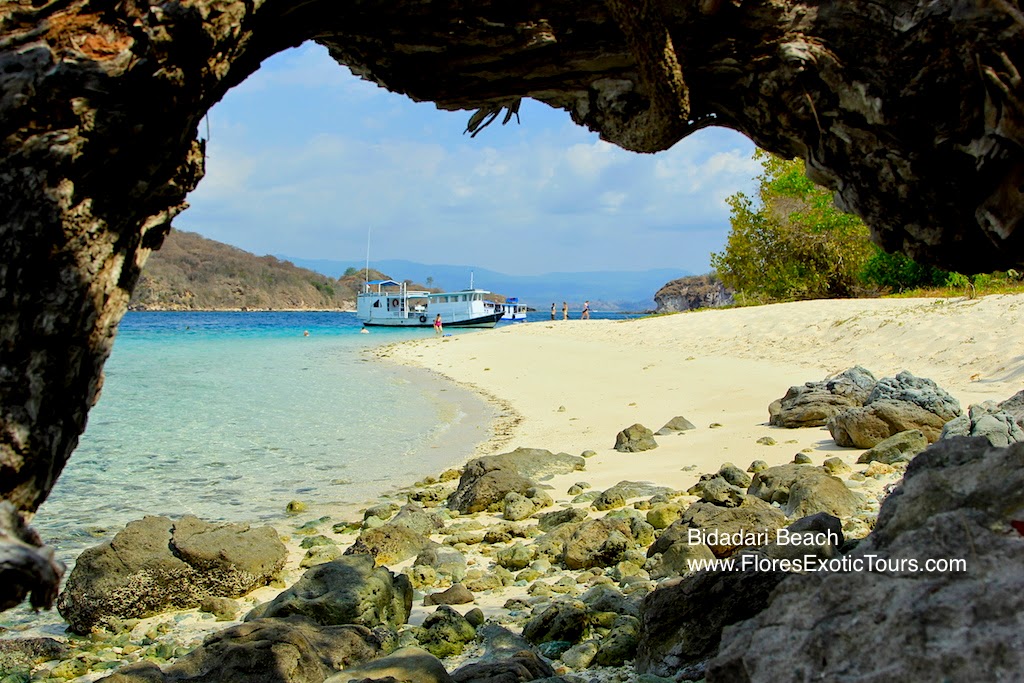
Pulau Bidadari

Pulau Bidadari
Pulau Bidadari, which means ‘angel island’ in Indonesian, is a small, charming island located northwest of Labuan Bajo. This island is a water lover’s paradise. Its excellent white-sand beaches seem to have come from paradise, and its crystal clear and calm waters make it an ideal spot for swimming, snorkeling, and especially learning how to dive. Bidadari Island, reachable by way of a short 15–20 minute boat trip, is a tiny island. Its 14–15 hectares are covered with hills and trees, and it is almost completely surrounded by beautiful beaches.
Text : www.florestourism.com
Photography: Leonardus Nyoman (www.floresexotictours.com)


Wednesday, May 4, 2011

Giant Lizard, Komodo Dragon

The Komodo Dragon


“The Komodo dragon, as befits any creature evoking a mythological beast, has many names. It is also the Komodo monitor, being a member of the monitor lizard family, Varanidae, which today has one genus, Varanus. Residents of the island of Komodo call it the ora. Among some on Komodo and the islands of Rinca and Flores, it is buaya darat (land crocodile), a name that is descriptive but inaccurate; monitors are not crocodilians. Others call it biawak raksasa (giant monitor), which is quite correct; it ranks as the largest of the monitor lizards, a necessary logical consequence of its standing as the largest lizard of any kind now living on the earth…. Within the scientific community, the dragon is Varanus komodoensis. And most everyone calls it simply the Komodo.” Claudio Ciofi


The Komodo dragon is an ancient species whose ancestors date back over 100 million years. Komodo dragon in Rinca islandThe varanid genus originated between 25 and 40 million years ago in Asia. The Komodo descended from this species and evolved to its present form over four million years ago.
The Komodo is long lived (as are most of the larger reptilian species) with an estimated life expectancy of over 50 years in the wild. In keeping with its longevity, the Komodo matures late in life, becoming sexually viable at five to seven years, and achieving maximum body density in fifteen years. Komodos are sexually dimorphous, which means males are bigger than females. The largest recorded specimen was 3.13 meters in length and was undoubtedly a male. Females rarely exceed 2.5 meters in length. What is perhaps more important, is that the characteristic bulk is achieved by older dominant males in clearly delineated territorial areas. As an adult Komodo can consume up to 80% of its body weight in one gorging, weight is a highly variable factor, and is largely dependent on the most recent feeding. A typical weight for an adult Komodo in the wild is 70 kilograms.Komodo Dragon


Komodo dragons are first and foremost opportunistic carnivores, and predators second. Although the Komodo can sprint briefly at 20 kilometers an hour, it does not chase down game as do the larger mammalian predators. The Komodo is a stealth predator, which lies motionless and camoflouged alongside game trails for the unwary, which tend to be the very young, the old and the infirm. In an attack, the Komodo lunges at its victim with blinding speed and clasps it with the serrated teeth of the jaw. Prey are rarely downed in the initial attack unless the neck is broken or caratoid artery severed. The more likely outcome is escape, followed by death a few hours or days later from septicemia introduced by the virulent strains of bacteria found in the saliva of the Komodo dragon (the Komodo survive primarily on carrion and ingest the bacteria when feeding).


The Komodo has two highly developed sensory organs – the olefactory and the Jacobson’s - which allow the dragon to detect rotting carcasses from distances as great as 10 kilometers. The yellow forked tongue is
constantly being flicked in and out of the mouth, “tasting the air”, and inserted into the Jacobson’s organ located in the roof of the mouth. The individual tips are highly sensitive and are capable of discriminating odors in the magnitude of millionths of a part. Using the information garnered, the dragon wends in a seemingly random, winding path which becomes straighter the closer it approaches to the carrion. The Komodo is typically a communal feeder and any number of dragons might arrive at the site of the carcass.
Socialization occurs during feeding at carrion sites, as does mating. The abdomen is slashed first and the intestines and stomach contents scattered. Young juveniles roll in the fecal matter to mask their scent from aggressive adults, which attack and sometimes kill juveniles during feeding. The dominant male feeds until sated, followed by other dragons in order of size. While the dominant male is gulping down hindquarters and ribcages, the braver dragons chance foraging a few scraps. Virtually the entire carcass is consumed in the process– head, fur, hooves and bones. After feeding, the Komodos become quiescent and approachable while their digestive tracts are converting the food into fat energy stored in the tail.


Between the months of May and August, mating occurs at and around feeding sites. As males outnumber females in a ratio of nearly four to one, the dominant male must fend off other suitors before mating. Males will engage in slashing, biting and bipedular rearing onto the tail, until the dominant male is acknowledged by displays of subservience and the vanquished flees. The female is forced into a prone position while the male tongue flicks her body, and in particular, the fold between the torso and the rear leg close to the cloaca. With Komodos, the male hemipenes are located here as are the female genetalia. Once prone, the male mounts onto the back of the female and inserts one of the two hemipenes into her cloaca , depending on which side he is perched. The month of September is when a clutch of 15-30 eggs is buried in a nest dug with the powerful claws of the female dragon. A typical nesting site is in the composting vegetative mounds of the maleo birds which are indigenous to Komodo.
The gestation period for the eggs is eight to nine months. Hatchlings, which average 40 centimeters in length and weigh 100 grams, emerge from the nest in April and immediately scramble up the nearest tree to avoid being eaten by the adults. There are plenty of small lizards, insects and mammals in the canopy after the brief rainy season in January and February to sustain the juveniles until they descend to the forest floor roughly a year later. This period of change between an arboreal and a terrestial habitat, when the juveniles are a meter in length, is a time fraught with danger. The juvenile Komodo is just too bulky to safely ascend many trees, and not big enough to outrun a ravenous and determined adult. Cannibalism is a fact of life for this species, and perhaps is an evolutionary response to the harsh, arid climate of Komodo.
Prey species for the dragon on Komodo island include deer, boar, wild buffalo, the maleo bird, snakes, reptiles and small mammals. On Rinca, the monkeys and wild horses found there are also constitute prey, as do the goats raised by the local people. On the odd occasion people are also attacked by the Komodo dragon. There have been eight recorded instances of attacks on humans since Komodo has become a national park, almost all of which occurred on Rinca.