Showing posts with label indonesia. Show all posts

Monday, February 27, 2017

Pasola Festival, Sumba island


The Pasola Festival is an original war ritual for giving thanks to the ancestral spirits in the region of West Sumba, East Nusa Tenggara. Therefore two groups of 25 men each, mostly from the upper and the lower village, are fighting each other while riding horses and throwing their wooden spears toward the opponent. The initiating prayer is lead by the Rato, a traditional priest, and after he threw symbolically his spear between the groups, the “war-game” immediately starts. The selected proud Sumbanese men and also their horses are wearing traditional and colorful clothes during this ceremony.


This festival is held every year in February and March in Kodi and Lamboya, unfortunately the exact dates not predictable, because it is decided by the Rato and announced only one or two weeks before.
The word Pasola derives from Sola or Hola, which means a kind of a long wooden stick used as spear. The Sumbanese people believe that the festival creates a balance between material and spiritual needs in order to live happily in earth and in heaven. It contains also a sacrificial thought so that a certain bloodshed is considered to be essential. Pasola is usually the climax of a whole series of activities to celebrate the feast Nyale. Pasola is believed to be the order of the ancestral population of adherent Marapu and expresses the essence of religion.

Friday, May 20, 2016

FLORES TOURIST ATTRACTION, FLORES ISLAND - INDONESIA


Labuhanbajo - West Flores - Indonesia

A little town inhabited by fishermen, lies at the extreme western part of Flores Island. The town serves as a jumping off point for the trip to Komodo Island. It is a beautiful area for water skiing, wind surfing, fishing and many other marine activities.
Batu Cermin Cave is five kilometers from the town of Labuanbajo. It can be reached partly by car, and partly on foot. The grotto is 75 by 75 meters large, and contains stalactites and stalagmites. Some tunnels are narrow and dark but in others sunlight falls.

R U T E NG
Rice field terraces near Ruteng Flores island

Ruteng is the capital of Manggarai Regency that was once ruled by the kings of Bima. The influences of Bima. The influences of Bima and Goa are evident in prevailing titles, such as Karaeng, and in the manner of dress. The shape of the roofs with the buffalo horn symbol, may be an element inherited from the Minangkabau. The cool town of Ruteng lies at the foot of a mountain. It can be reached by air from Kupang or Denpasar via Bima, or by ferry from Bima via Labuanbajo, or from eastern part via Ende and Bajawa. Beside the fame Komodo lizards, the area has many attractions to offer the tourists, such as the caci dance, a wildlife reserve, and archeological caves.
Cancar;Golo Cara; the unique lingko rice fields, circular terraces arranged like a spider web.
Liang Bua: the place where Homo Floresiensis was founded by the archeopathology of new England university of Australia and from Indonesia. The tiny skeleton called Hobbit was discovered during a three-month excavation inside Liang Bua, Scientists believe it may represent a new human species, Homo floresiensis, The species existed alongside modern humans as recently as 13,000 years ago, yet may descend from Homo erectus, which arose some two million years ago.

Mount Inerie-Ngada-Flores island
 
The capital of Ngada is Bajawa, which lies in the middle of the cool highlands. It is a pleasant little town such as is seldom found elsewhere in Flores. About 135 kilometers from Ruteng all about 5 to 7 hour - driving distance by car, Bajawa can also be reahed from Kupang by air-craft, and from Ende by car.
Abulobo and Inerie are between mountains with sharp peaks known locally as the "sky pillars", and popular among mountaineers. They are located near coast and have wonderful scannery.

B E N A
Bena Traditional village-Ngada Flores island
 
Bena is prototype of an ancient Ngada village. Such villages are found in rather great numbers in the area and can be reached by car from bajawa in about one and half hours. The way of life of the people is unique, and so are the houses and the traditional ceremonies.

R I U N G
Riung Marine Park - 17 Pulau
 
Riung is now wellknown for its seventeen isles that makes the sea surrounding a paradise for marine lovers. Here one can dive, snorkel, and swim.
The beach is a sea-side resort with clear and calm water. There is a beautiful coral reef just off the shore.

ENDE
Kelimutu Crater Lakes - Ende Flores island Indonesia
 
Ende was the site of a kingdom that existed around the end of the 1 8th century. The name today refers to the capital of the Ende regency, which includes the two autonomous territories of Lio and Ende. The people of the area therefore known as Lio Ende people. This town has for many decades been a center of government trade, education and political activity. Rebellion against the Dutch, led by a certain Nipa Do - known as the Wars of Watu Api and Mari Longa - decurred here in 1916 - 1917. And in 1934, the traditionalist leader Soekarno, who was later to become Indonesia's first president, was exiled to Ende by the Dutch colonial government.
The town Ende lies at the foot of mountains lye, lpi, Meja and Wongge. The beautiful bays of Ende, lpi, and Mbuu are favorite sites for beach-site recreation. Ende can be reached by aircraft from Kupang. And also from Denpasar via Bima, or by from Surabaya or Kupang.
The Bung Karno Museum is the old house occupied by Soekarno during his years of exile in Ende. Most of for the old furnishings are still there.
While in exile in Ende, Soekarno wrote and staged few plays, together with the Tonel Kelimutu theatre troupe. Among those plays were Rendorua Ola Nggera Nusa (Rendo That Stirred the Archipelago) and Doctor Satan, a revision on the story of Dr. Frankenstein.
Near the football field in Ende stands an old, big breadfruit tree. Under it, Soekarno often sat, working on political ideas to lead Indonesia towards independence. Those reflections presumably contributed to the opening of the Pancasila concept, which is now the state philosophy of the Indonesian Republic. Just from here was the Pancasila idea born. Today, the Pancasila Birth Monument stand on this precise spot.

KELIMUTU
Kelimutu crater lakes,Ende,Flores island
 
East Nusa Tenggara's natural wonder and one of Indonesia's most mysterious and dramatic sights that can be found on top this mountain, some 66 kilometers from Ende, or 83 kilometers from Maumere. It has a unique and spectacular view on its three crater lakes with their respective colors. The colors, however, have changed continually since the eruption of Mount /ye in Ende in 1969.
The mountain is located at the back of Mount Kelibara, in the Wolowaru District in the Ende, Regency of Central Flores. Keli means mountain and Mutu means boiling. In short, it means volcano. To the local people, this mountain is holy, and a token of God's blessings. It provides fertility to the surrounding lands. It is both heaven and the hell to the people of Lio Ende. Many travelers and scientists, have written about Kelimutu since it was discovered by Van Suchtelen, a Ducth government officer,
in 1915.
Father Bouman published an article in 1929, which made the name Kelimutu known all over the world. Since then, many researchers and tourits have come, as well as the Governor General of Batavia (Jakarta). To get to the lakes, one follows the road, from Moni, then proceed to the crater's top. Near the crater rim was a bungalow, which has now been dismantled.
The presence of the white men, or Ata Bara, was regarded disturbing to the peace of the ancestral spirits. As a result the spirits of Kelimutu disappeared. Earth quakes began rocking the land. Smoke is often released from the crater.
The eruption of 1928 caused many victims and much damage. In 1938 there was another eruption, coming from Tiwu Ata Koo Fai Noo, Ata Nuwa Muri (the Lake of Youth). The biggest took place in 1968, in which the water in the lakes was shot 10 kilometers high into the sky. The peak of Kelimutu itself is 1,690 meters high, and its lake crater I ,410. Other geological data are as follows: Tiwu Ata Polo (the Lake of Evil) has a slopping wall, 150 meters high. The lake is 380 by 280 meters large and 64 meters deep. The volume of the water is about 446,000 cubic meters.
Tiwu Ata Koo Fai Noo and Ata Nawa Muri (the Lake of Youth) has walls 128 meters high. The lake is 430 by 300 square large and 127 meters deep with a water content of about 500.000 cubic meters.
Timu Ata Bupo (the Lake of the old) has twi layers of walls, 240 meters high. The lake covers a surface of 300 by 280 meters high. The water is 67 meters deep and 345,000 cubic meters in volume. The total water content of the three lakes amounts to 1,3 million cubic meters.
In the last three ti five years, the lakes of Kelimutu have changed in color, a phenomenon caused by the geological and chemical processes in the bottom and walls of take lakes. It could also have resulted from changes in the bacteria and micro organism populations due to changes in temperature.
Another theory proposed by village elders, is that there has actually been no change at all, but that the effect is due to optical illusions. To reach Kelimutu can be done by flying to Ende or Maumere, then going by car to Kelimutu.
The surrounding villages are good places serving as bases for visits to Kelimutu, particularly those who wish to have a more leisurely pace and enjoy the views along the road between Ende and maumere, or spend more time in Kelimutu. Those title villages are also known for their excellent weaving all hand made, still use natural dyes.

MAUMERE
Lepo Lerun - weaving ikat - Nita - Maumere
 
A port town on the northeastern coast of Flores and stopover on the way to Ende or to Denpasar, and Ujungpandang, and noted for its good beaches. The bay of Maumere, Waiara, is considered the best diving spot (Flores Marine Resort) as it promise extremely rich marine life.
The resort is a paradise for all divers, underwater photographers, and for everyone interested in marone biology. It has a beautiful sea
garden filled with corals and fish. So does Koka, nearby. Accommodation and facilities for recreation are available.
Ledalero Museum at the outskirts of Maumere has an interesting collection of ethnological objects for the region. Visitors are welcome but advanced arrangements should be made. Ledalero is also a name of a major Catholic Seminary from many of Florinese priest originated.

S I K KA
Weaving ikat,Sikka Natar-Maumere Flores island
 
Sikka was in the past of kingdom, but is is now a regency. The capital is Maumere, on Maumere Bay on the north coast of Flores. The town can be reached by air from Denpasar, Kupang, and Ujungpandang, or by sea from Surabaya, and over land from Ende. Bare mountains and hills dominated the landscape. Today a reforestation program has turned large parts into green pastures.
A prehistoric bronze boat from the Dongsong era, called Dobo or Baobatung is found in a village near Maumere, where it is carefully kept by the people as an ancestral heirloom.
Paga is an old village near the beach. It was a refuge for Catholic missionaries who retreated to this area as the result of pressures by the Dutch authorities in Flores. There is an old well with clear water. Its location is 40 kilometers from Maumere. The small town Nitta was the site of kingdom, and is rich in historical places, traditional ceremonies and beautiful woven clothes with various motifs. It is located 10 kilometers from Maumere.
Sikka-Lela are the viliges which were formerly center from which the Roman Catholic religion spread across Flores. An old well, dug by the priest Le Cocg (1885), can still be found. Bola Beach is located in the southern past of Flores near Sikka and Lela. Many historical relies are found in these two areas, ranging from traditional houses, to rare ivory heirlooms. Ivory was in the past use as a dowry in marriage. Some of the villages in Sikka, such as Sikka, Lela and Nita produce beautiful ikat textiles with motifs that are peculiar to the region.
Like TanaKa, in Ende the soil covering hill near Lakebai is also edible. The grains of earth can be eaten after they are fried.
 
The island of Palue, in the north of Flores has a megalithic culture. In the front- yard of houses lie the graves and "mezbah" offering stones. The people of the area are known to make great sailors. Life is still much influenced by the belief in spirits, which are believed to reside in natural objects. The island can be reached in a few hours by motorboat from the Maumere prier.

Tuesday, October 21, 2014

Perkampungan Adat dan Benteng None - So'e - TTS - NTT

Perkampungan Adat dan Benteng None


Salah satu daya tarik adalah perkampungan adat masyarakat adat None, yang dihuni oleh marga Tauho. Di tempat ini anda bisa menyaksikan Rumah-rumah adat orang Timor berupa Ume Kbubu (Rumah Bulat) dan Lopo.
Dalam filosofi orang Timor, Rumah Adat Ume Kbubu melambangkan wanita orang Timor yang santun, bersahaja, merenda dan tertutup auratnya sebagaimana dilambangkan oleh ume kbubu, dimana atapnya dari bubungan sampai ke tanah, dan memiliki satu pintu saja, sehingga orang keluar masuk harus menunduk. Sementara Lopo, bagi orang Timor melambangkan laki-laki, dimana agak terbuka, kokoh, dan sebagai tempat untuk pertemuan keluarga, dimana selalu dipimpin oleh bapak selaku kepala keluarga.
Terdapat Benteng Pertahanan Masyarakat Adat None pada jaman dahulu melawan musuh dan penjajah. Benteng tersebut terbuat dari batu-batu alam dan sejenis tanaman berduri (Naus) yang ditanam berjejer sepanjang 1 km, sementara pada sisi yang lain, terdapat jurang yang sangat terjal sehingga musuh sangat sulit sampai ke perkampungan mereka.

Tarian Perang (Ma'ekat)
Dalam tarian ini disuguhkan ketangkasan, kepiawaian, keberanian dan keheroikan para panglima dan prajurit perang (meo) dalam memerangi musuh di medan laga, yang kemudian memenangkan pertempuran dan melanjutkannya dengan pesta pora kemenangan lewat Tarian Bonet. Sejenis tarian gembira yang mengambil formasi bulatan sambil bergerak seiring jarum jam dengan panduan lantunan syair-syair pantun yang disebut ”Tne”.

Upacara Adat Poit Pah
Upacara adat syukuran panen ini, biasanya dilakukan oleh orang Timor dalam memasuki musim panen, bersyukur kepada Allah sang pemberi rejeki atas hasil panenan yang melimpah sembari memohon berkat atas tanaman untuk musim tanam mendatang. Prosesi upacara adat ini, diawali dengan doa yang dilakukan oleh tetuah yang telah ditunjuk (Ana,am Nes).Korban-korban berupa ternak sapi dan babi serta hulu hasil yang telah disiapkan didoakan dan kemudian dipersembahkan pada mesbah yang ada di bawah sebatang pohon beringin besar. Darah sembelihan kemudian diperciki pada hulu hasil yang ada.

Upacara Adat Ote Naus
Upacara adat yang satu ini biasa dilakukan oleh masyarakat adat Timor untuk mendeteksi lawan / musuh sebelum melakukan perlawanan. Sarana yang digunakan adalah sebilah tombak yang diarahkan ke tiang pancongan kemudian mendepa dan apabila depaan tangan mencapai tiang pancongan, maka itu menandakan ada keberuntungan, dan sebaliknya manakala tangan tidak mencapai tiang pancongan, menandakan ketidakberuntungan, dan itu berarti masih ada sejumlah kendala yang perlu dibenahi dengan cara naketi.

Photography: Leonardus Nyoman

Monday, October 13, 2014

Pulau Bidadari

Pulau Bidadari
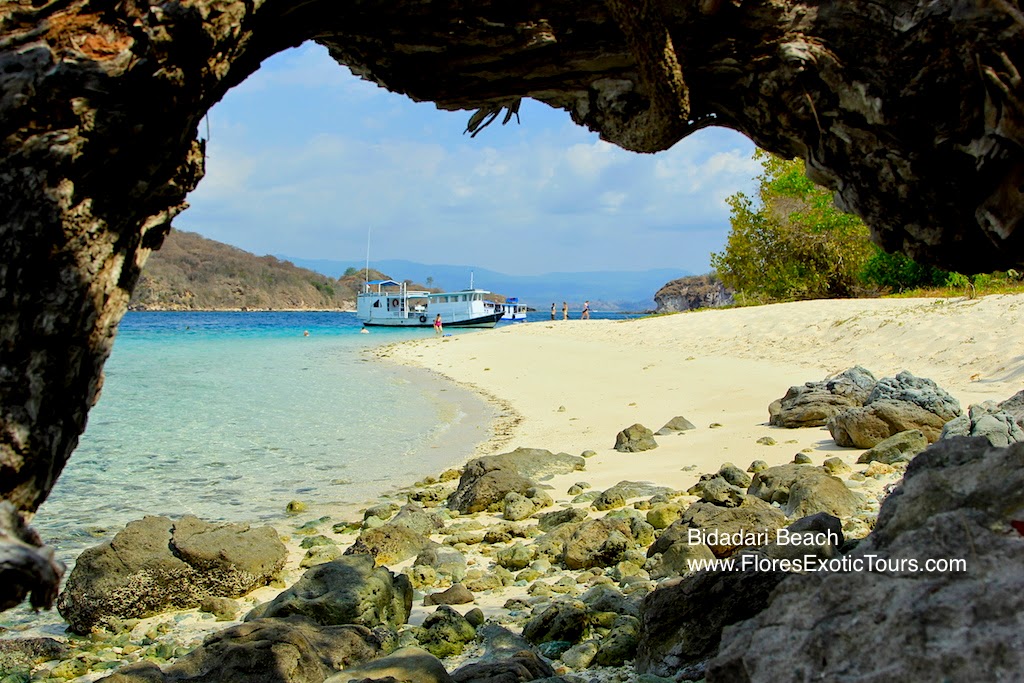
Pulau Bidadari, which means ‘angel island’ in Indonesian, is a small, charming island located northwest of Labuan Bajo. This island is a water lover’s paradise. Its excellent white-sand beaches seem to have come from paradise, and its crystal clear and calm waters make it an ideal spot for swimming, snorkeling, and especially learning how to dive. Bidadari Island, reachable by way of a short 15–20 minute boat trip, is a tiny island. Its 14–15 hectares are covered with hills and trees, and it is almost completely surrounded by beautiful beaches.
Text : www.florestourism.com
Photography: Leonardus Nyoman (www.floresexotictours.com)


Saturday, April 12, 2014

Islands around Labuanbajo - Flores - Indonesia

 Bidadari Island


Pulau Bidadari, which means ‘angel island’ in Indonesian, is a small, charming island located northwest of Labuan Bajo. This island is a water lover’s paradise. Its excellent white-sand beaches seem to have come from paradise, and its crystal clear and calm waters make it an ideal spot for swimming, snorkeling, and especially learning how to dive. Bidadari Island, reachable by way of a short 15–20 minute boat trip, is a tiny island. Its 14–15 hectares are covered with hills and trees, and it is almost completely surrounded by beautiful beaches.

Seraya Kecil island


Only 10km from Labuan Bajo lies the small but charming Seraya Island (official name: Seraya Kecil) – a place where chilling out on white sandy beaches, swimming in the clear, calm and turquoise water or exploring the colorful underwater world with just some goggles and a snorkel make up your daily routine. Around the small fishing village that is located on the southern tip of the island, you can get an impression of the bagan style of traditional fishing with its bamboo structures erected over the open sea.

Kanawa island
 

Kanawa Island, located approximately 15 kilometers from Labuan Bajo at the border of Komodo National Park, is considered to be one of Southeast Asia’s most idyllic islands, fully surrounded by a spectacular reef with thousands of fish species, turtles, corals, reef sharks, and mantas. A small hill in the middle of this untouched island guarantees a spectacular view over the national park and to Labuan Bajo Bay. From here, you can enjoy the most breathtaking sunrises and sunsets.
Facilities
On all of these small islands, you will find accommodation in the form of basic bungalows which are located almost directly on the beach. There are also a number of small restaurants.
However, equipment for snorkeling cannot be rented on every island. On Bidadari you should have your own snorkeling gear which can be obtained from a dive rental place in Labuan Bajo; whereas on Kanawa and Seraya you can rent the equipment directly on the islands.
If you’re up for diving, you should check before departing whether either renting the equipment is possible on the island or whether you should first arrange it from Labuan Bajo.
Bidadari Island is managed by Reefseekers for dive resorts; however for diving activities with them, you need to make an arrangement in their Labuan Bajo office, not on the island. Kanawa island is developed by an Italian company, where diving is possible without any arrangements in Labuan Bajo.
There are further more stunning islets around Labuan Bajo, as such as Kalong and Monkey islands, easily reachable and both offer good opportunities to explore Flores’ exotic fauna. As there is no accommodation on these islands yet, visits are limited to day trips. However, the islands are so close to Rinca and Komodo islands that some local tour operators offer overnight stays in villages on both islands.

Kalong Island (Pulau Kalong) is a place where you can enjoy the bustling activities of thousands of flying foxes every evening. It is located only 16km from Labuan Bajo.  

Monkey Island (Pulau Monyet) is a spot where plenty of smart monkeys will entertain you with their amusing behavior. It is located only 800 meters from Labuan Bajo.
Text by: http://www.florestourism.com/where-to-go/islands-around-labuan-bajo-0
Photography by Leonardus Nyoman

Monday, November 12, 2012

ALOR ISLAND - EAST NUSA TENGGARA PROVINCE


Alor is the largest island in the Alor Archipelago located at the eastern-most end of the Lesser Sunda Islands that runs through southern Indonesia, which from the west include such islands as Bali, Lombok, Sumbawa, Komodo, and Flores.
To the east of the island across the Ombai Strait lie the islands of Wetar and Atauro, the latter belonging to East Timor. To the south, across the Strait of Alor, lies the western part of Timor. To the north lies the Banda Sea. To the west lies Pantar and the other islands of the Alor archipelago, and further yet the rest of the Sunda Islands.

Geography
Alor has an area of about 2800 km², making it the largest island of the Alor archipelago.
Kalabahi is the only town on the island of Alor, with a metropolitan population of about 60,000. The variety of goods obtainable in Kalabahi is surprising considering its size and location.
Alor is of volcanic origin and has very rugged terrain. The region near Kalabahi is the only flat area. This is why the Dutch placed the capital and the main harbor (Alor-Kecil) of the area here in 1911.
"The best" snorkelling and diving in Indonesia can be found in the Alor archipelago. Due to intriguing and often very strong currents it is best to snorkel or dive with someone who knows the area well. Transportation to Alor by TransNusa Trigana Air, from Kupang, Denpasar and Surabaya.

Economy
The island's infrastructure is only weakly built. The inhabitants practice mainly subsistence agriculture. The government seeks to change this with the help of international organizations. In the villages vanilla, tamarind, almonds and other nuts are cultivated. In the forests sandalwood is cut down for trade.
The latest geological explorations have discovered valuable resources such as gipsum, kaolin, petroleum, natural gas, tin, gold, and diamonds.
Alor's highly-esteemed snorkeling and diving promise an increase in tourism in the future. Depletion of the fisheries has however damaged the coral reefs in recent years.

Religion
Over 168,000 people live on Alor. Three-fourths are protestants, the rest are either Muslims or in a few villages Roman Catholics. Animistic rites and traditions are still strongly practiced.

Language
More than 15 different indigenous languages are spoken on Alor, the majority of them classified as Papuan or non-Austronesian. These include Abui, Adang, Hamap, Kabola, Kafoa, Woisika, Kelon, and Kui. In addition, Alorese (Bahasa Alor; ISO 639-3: aol) is a Malayo-Polynesian language which is spoken along the coast of the western and southern Bird's Head of Alor Island and in places on surrounding islands.
Many of the Papuan languages of Alor are endangered and are no longer being actively acquired by children. Some languages have fewer than 1000 speakers remaining. Significant linguistic documentation efforts have been undertaken recently by Leiden University.
The language of daily communication is Alor Malay, a unique Malay variety with some similarities to Kupang Malay. Indonesian is taught in schools and used widely in media.

Sources           : http://en.wikipedia.org/wiki/Alor_Island
Photography  : Leonardus Nyoman / www.floresexotictours.com

Thursday, November 8, 2012

FLORES TOURISM OBJECT

Labuan Bajo-west Flores.
Labuan Bajo
Labuan Bajo is the capital of the district of Manggarai Barat (West Manggarai) and is located at the westernmost tip of the island. Labuan Bajo is a launching point to explore the island’s interior and visits the giant dragons on Komodo and Rinca Island. It is almost a must-do for visitors to hike to one of the surrounding hills or mountains to enjoy a perfect panoramic view over the harbor and the innumerable coastal islets with their strips of white-sand beaches.
Waerebo Traditional Village.
Cunca Rami Waterfall
The impressive Cunca Rami waterfall, with its many pretty pools that offer a refreshing, natural swimming experience, makes a fantastic day trip from Labuan Bajo. Hiking through small villages and agricultural land, this walk is also a lesson in culture and agriculture. The trail leads you across various villages before it stretches out into open farmlands with water buffaloes, pigs, and goats grazing freely in the fields.
You can observe the various stages of rice cultivation and the traditional drying methods throughout the trail. Keep an eye out for banana, cacao, vanilla, and avocado plantations – it is amazing how everything grows and prospers seemingly effortless in this fertile area.
Sprider web rice field-Cancar.
Mount Mbeliling
Mount Mbeliling, located in West Manggarai, is the highest mountain in this region. The Mbeliling Forest Reserve, which spans over an area of 15,000 hectares, is the habitat of numerous endemic plant species and birds. Its large variety of flora and fauna make it a perfect trekking destination, especially during the dry season.
Bena Traditional village of Ngada.
Riung Marine Park.
Kelimutu Lake.
Sano Nggoang Crater Lake
Sano Nggoang Crater Lake is located approximately 35km east of Labuan Bajo. With depths of up to 500m, it is said to be among the world’s deepest crater lakes. The lake and an overall surrounding area of 5,500 hectares are proposed to become a protected area due to the remaining forests and endemic bird species such as the native Flores crow and the Flores monarch. Enthusiastic bird watchers and nature lovers should make sure to bring along their binoculars. Besides the birds, there is an abundance of attractive flora and fauna that can be spotted in this area.
Sano Nggoang offers the full range of nature tourism attractions and activities, from hiking to bird watching, swimming, or simply relaxing in a natural hot spring. What’s more, it offers you to gain an insight in the local people’s customs, traditional farming practices, and everyday life.
You can also do other activities such as:
•    Hiking and trekking
•    Swimming
•    Therapeutic soaks in local hot springs
•    Bike tours (if you bring your own bike or rent one in Labuan Bajo)
•    Local horse excursions along the shoreline
•    Nature tours:
        Bird watching
        Flora and fauna discovery
•    Agricultural insights:
       Traditional cultivation and irrigation systems
       Care and propagation of domesticated animals
       Cultivation of cash crops in combination with traditional crops
•    Culture:
       Local handicrafts
       Village traditions, dances, and local traditional ceremonies
Batu Cermin Limestone Cave
Batu Cermin cave is set within an impressive prominent rock formation near Labuan Bajo. Through a hole in the cave, rays of light find their way into the cave’s inside walls where they perform a spectacular show of reflected sunlight. This fascinating effect is caused by some slick, mirror-like rock surfaces that reflect the light. Hence the cave’s name, Batu Cermin, which means ‘mirror rock’ in Indonesian. If you want to experience this visual delight in all its beauty, make sure to be there at the right time: depending on the time of year, the sunrays only hit the hole between 9 and 10am.
Ruteng Pu’u
The traditional village of Ruteng Pu’u, located 4km from Ruteng, is one of the most popular places to see the traditional compang, a round, stone platform surrounded by a circle of stones and traditional houses. The compang  is the center of traditional ceremonies and rituals, e.g. for sacrificial offerings. An impressive waringin tree (Ficus Benjamina), locally known as a ‘ruteng’, once grew in the center of the compang.  It is now replaced by a dadap tree. On the east side of the compang, there are two tall traditional houses with spiked roofs.
Tengkulese Waterfall
Tengkulese Waterfall, which is also referred to as Cunca Lega (cunca means ‘waterfall’ in the Manggaraian language) is named after the nearby village. The water drops over two levels with a promising altitude. Surrounded by a lush forest and rice terraces, it can even be spotted from a distance. The waterfall can be reached by way of a nice short hike.
Wae Rebo Village
Wae Rebo is an old Manggaraian village, situated in pleasant, isolated mountain scenery. The village offers visitors a unique opportunity to see authentic Manggarai housing and to experience the everyday life of the local community. In the village of Wae Rebo, visitors can see mbaru niang – traditional, circular cone-shaped houses with very unique architecture. Nowadays, it is still a place to hold meetings, rituals and Sunday-morning prayers together.
Wae Rebo has been supported to become the major culture tourism attraction in West Flores. Together with a team of Jakarta-based architects and the Indonesian government, the local community renovated four of their
Liang Bua
With this finding, long-held scientific theories on the evolutionary past of human beings were contested: was there a land connection between mainland Asia or Australia and Flores? Was the isolated island situation responsible for the dwindling size? Did modern human beings cross with the hobbit, or did a volcano eruption end to the hobbit population before modern human beings settled on Flores? Is it really a new kind of human being, or did it suffer from a disease causing dwarfism? Father Verhoeven, a Catholic missionary of the SVD order, was the first to undertake archaeological excavation in Liang Bua. After Verhoeven, further research by Indonesian archaeologists was undertaken, confirming the assumption of human occupation. Archaeological excavation is still going on, with further discoveries of the bony remains of stegodons, varans, rats, birds, and stone artefacts. Old Manggaraian myths and tales about small people living in caves are still doing the rounds.
Cancar Spider Rice Fields
In Manggarai you will certainly notice the impressive lingko fields. The most amazing view over a number of these fields is offered at Cara Village situated on a small hill 17km west of Ruteng in Cancar. With their round, spider-web structure, these pieces of land are unique eye-catchers in Manggarai. The lingko fields are primarily used for wet-rice cultivation. With the dominance of this new form of farming, the significance of the traditional agricultural calendar with its rituals and ceremonies, embedded in the planting and harvesting of dry rice and corn, has also faded.
Ranamese Lake
Ranamese, a mountainous natural reserve (Taman Wisata Alam), impresses with its dense forests and a 21-meter-deep crater lake at an altitude of 1220m. Ranamese is ideal for those who want to explore the Florinese highlands by trekking. It is also a perfect place for bird watchers.
Ranamese Lake is situated in the middle of the forest, surrounded by a dense vegetation of mosses, scrubs, tropical woods, and water plants. The climate is comfortably fresh. Its calm and clear water makes it easy to spot freshwater fish. Other prominent animals around the lake are the wild macaques.
Bena Village
Bena, a community that is situated about 16km from Bajawa at the foot of Mount Inerie, is the most famous and also most visited village in the Ngada district. With its impressive stone formations and ancestral shrines, as well as traditional houses, Bena has turned into a signpost for Ngada culture. The village consists of two parallel rows of traditional, high thatch-roofed houses. Highly visible in the center of the village are ngadhu and bhaga, pairs of shrines – one for each clan of the village – representing the clan’s ancestors. The ngadhu is an anthropomorphic umbrella-like pole embodying the male ancestor of a clan. The trunk is decorated with carvings and is topped with a warrior-like figure. The ngadhu symbolizes fierceness and virility. After a new ngadhu has been carved out of a special tree, the men of the village carry the pole in a ceremonial way into the village. The bhaga, a female ancestral clan shrine, is a small hut with a thatched roof that resembles a miniature of a traditional house. It symbolizes the sanctuary of the house and the female body. The bhaga offers enough space for one to two persons to hold rituals for female ancestors. 
Mangeruda Hot Springs
Located in the Soa sub-district, about 23.5km from Bajawa, Mangeruda Hot Springs offer you the Florinese highlands at their warmest. Travelers coming to Ngada often visit Mangeruda Hot Springs to escape chilly Bajawa and enjoy the warm water that flows from a river under the shade of coconut trees. The spring water is believed to have curative effect for those suffering from skin conditions. Howsoever, the experience of taking a warm, soothing bath in a beautiful, natural atmosphere is definitely a true delight for your body and soul. Some pools are especially designed for visitors, including a large, artificial pool that offers space for quite a lot of people.
While in Soa, you may have the chance to enjoy ‘sagi’, a traditional boxing performance which is the pride of the Soa community. Usually held after harvest or during the dry season from May to July, sagi is performed continuously throughout the Soa sub-district, starting from Mangeruda and continuing to other nearby villages. It is performed as one of the local traditional festivals inspired by ancestral migration journeys in centuries over the distant past.
Riung 17 Islands
The sub-district of Riung, located to the north of Bajawa, is famed for its beautiful coral gardens. The coast and the surrounding area of the town of Riung have become a national conservation area, and were even given the status of a national park and named Pulau Tujuhbelas, or ‘Seventeen Islands’. In fact, the national park consists of more than 20 small and larger islands. The local people, though, have named the area ‘Riung Seventeen Islands’, a label that is easy to remember as it refers to the personification of a beautiful 17-year-old girl and also Indonesian Independence Day on the 17th of August.
The national park area is inhabited by various exotic species, e.g. the Timor deer, hedgehogs, monkeys, ferrets, the Timor monitor lizard, marsupials, and partridges. The large variety of birds, such as eagles, white herons, black storks, partridges etc, make the area a great spot for bird watching.
The Riung waters are home to plenty of exciting animals, ranging from marine mammals such as dolphins and whales to various colorful fish.  The crystal-clear water makes it a perfect place for swimming, snorkeling, and underwater photography. The biggest island is the hilly Ontoloe,  which is covered with short grass and a few trees, as well as fringed with mangroves. On the north coast of Ontoloe, you can observe the famous large fruit bats, called ‘flying foxes’, flying over the mangrove trees. A visit to Kalong, the ‘Flying Fox Island’, gives you the opportunity to see these fascinating animals as they fly into the sunset. The island of Bampa Barat is a temporary home to several fishermen, who sometimes sell their catch of the day directly from the boat.
Kelimutu
Mount Kelimutu, with its tri-colored crater lakes, is probably the most amazing natural phenomenon in Flores. Beyond that, the ‘steaming mountain’ is also the island’s most famous tempat angker, or mystical, haunted place. Scientific explanations aside, there are many myths about the origin of Kelimutu. This is one of the reasons why Mount Kelimutu was, and still is a sacred place for the local people. Over the years, the three crater lakes have often changed color. At present, one of the lakes is black-brown, one is green, and one is currently changing from green to a reddish color. A reason may be the varying mineral contents of the water. Another explanation suggests that the changing colors are caused by the neglected ancestral souls.
The first lake is named Tiwu Ata Mbupu (lake of the ancestors' souls ); the second is named Tiwu Nuwa Muri Koo Fai (lake of young people’s souls); and the third is called Tiwu Ata Polo (lake of evil spirits). The first and second lakes are situated close together; while the third lake is about 1.5km to the west. Kelimutu is a beautiful place at any time of the day. However, the best time to enjoy this magical place is in the early morning when the clouds haven’t yet covered the view. Many visitors prefer to see the sunrise.
The most popular and convenient starting point to visit Kelimutu is Moni, a village close to the Transflores ‘highway’. Whereas until not too long ago visitors had to hike all the way up to Kelimutu, there is now a paved road to a parking lot where you can enjoy a 30-minute walk through a lush forest full of birdsong, before entering the lake area.
The Kelimutu crater lakes are only a small part of the Kelimutu National Park. This fascinating area belongs to the worldwide protected areas and is internationally recognized by the United Nations Environment Program. Due to its unique natural features, its high biodiversity, and cultural heritage, Kelimutu National Park attracts thousands of tourists each year. Numerous hills and mountains (Mount Kelibara is the highest peak at 1,731 m) give this region its characteristic touch and provide a habitat for at least 19 rare, endemic bird species. As in so many places in Flores, traditional architecture, dances, and ikat weaving are still deeply rooted among the local people.
Maumere
Maumere, the capital city of the Sikka district, is a main entry point for visiting Flores. In contrast to Labuan Bajo, there are still few tourists in Maumere and has kept its charming atmosphere – a mix of a dusty, busy town and a coastal paradise. From Maumere you can explore plenty of exciting places in just a one-day trip. The surrounding areas are full of natural attractions and cultural highlights, hidden in either nearby or remote villages. There are plenty of small islands that are easily reachable from Maumere. The Pemana Islands, a chain of islands, are located about 7km from Port Sadangbui, Maumere. Island hopping combined with snorkeling on a beautiful coral reef, as well as relaxing on fine, sandy beaches are perfect things to do there. Maumere’s Port Sadangbui is one of the biggest harbors in Flores and therefore a central trading point. Boats from all over Indonesia, especially from Java, anchor here and turn the harbor into a busy coming-and-going of people and goods that is exciting to watch.
If you want to get a glimpse of Florinese cultural and natural history, prehistory as well as marvel at some unique and sometimes curious objects of art and daily life, Maumere’s Bikon Blewut Museum is the place visit. It is situated on the campus of Sekolah Tinggi Filsafat Katholik in Ledalero, which is a well renowned Roman Catholic seminary. The 6km distance from Maumere to Ledalero can easily be covered either by public or private transportation. Opening hours are Monday to Saturday mornings from 7am – 1pm
Larantuka
Larantuka is the capital of Flores Timur. This coastal town used to be a naval base for trade and a central point for colonialization and clerical activities in Eastern Indonesia. Nowadays, Larantuka is still an important connecting port to the neighboring islands and the center of economic activities in the Flores Timur district, attracting many people from the neighboring villages to make a living in the town. Having a long Catholic history, Larantuka hosts the famous Katedral Reinha Rosari. This cathedral, together with the two well-known chapels Kapela Tua Ana and Kapela Tuan Ma, are centers of activity during the famous Larantuka Easter procession. During Easter, this laid-back city turns into a busy and lively place bursting with pilgrims from all over the world.
Text Sources : www.florestourism.com
Photography : Leonardus Nyoman