Thursday, October 24, 2013

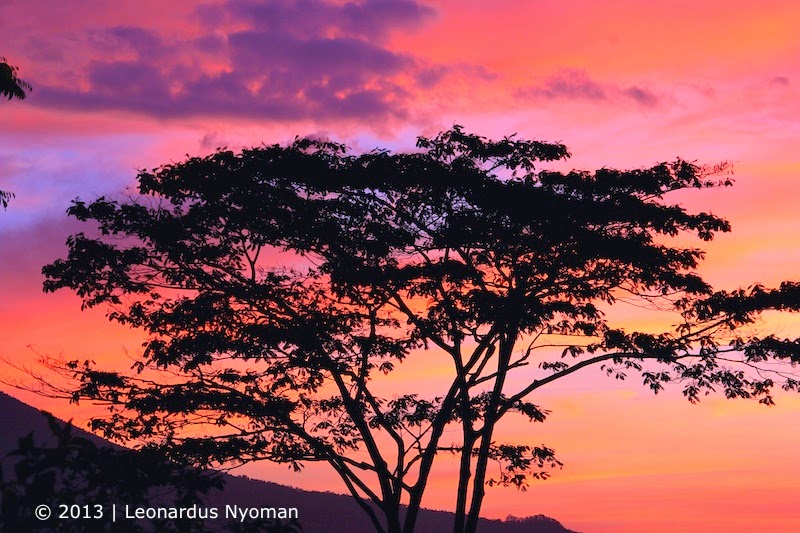
Senja di Ruteng 23 October 2013


Ruteng, the capital of the Manggarai district, is located at the foot of a high mountain range and in the center of a complicated network of valleys, which flow into the largest  rice-producing areas of Flores. Besides, the area around Ruteng is an important Indonesian coffee-producing area.
Due to its high altitude, Ruteng offers a pleasant, cool climate for relaxing. The mainly Catholic town is comparatively large, with supermarkets, various shops, and a soccer stadium. A lively market located towards the south of Ruteng is a central meeting point for people from the surrounding villages.
When driving into Ruteng you will certainly notice the red chapels of the Ruteng Cathedral, standing proudly in the town’s center. If you want to have an inside look, ask for the friendly pastor who is happy to show you the cathedral.
Long-standing traditions are still very much present in Ruteng, e.g. Caci: a whip fight which is an important element of traditional ceremonies. It is therefore often performed during the marriage of the wealthier and more influential Manggaraians. If you would like to experience such a ceremony, just visit the local market and ask the people there. Try to find someone who can translate your questions into the local language to avoid misunderstandings.
In Kampung Ruteng (or Ruteng Pu’u), which used to be an important ritual site, you can see a nice example of Manggaraian ‘compang’, a village center with the typical stone altar. The village is four kilometers north of Ruteng.
Photo : Leonardus Nyoman
Text : www.florestourism.com

Saturday, August 10, 2013

Upacara Roko Molas Poco


Upacara Roko Molas Poco
Kampung Leda - Ruteng 9 Agustus 2013.

Dilihat dari segi kata, Roko berarti mengambil, Molas diidentikkan dengan wanita cantik dan Poco berarti gunung.
Upacara ini merupakan upacara pengambilan kayu di hutan yang digunakan sebagai tiang utama dalam pembuatan rumah adat (mbaru tembong).
Dalam upacara ini “Molas Poco” yang diambil untuk dijadikan tiang utama (Siri Bongkok) yang akan dibuat dan diletakkan di tengah-tengah rumah adat yang akan dibuat; dan rumah adat yang akan dibuat tersebut berbentuk kerucut dan bagian ujung atas rumah dipasang tanduk kerbau (rangga kaba).

PUAR = ANAK RONA ULU DE  GOLO/BEO
Neka  pande nggosak agu locak adak tana Manggarai, Ai adak situ ceca mose dite. Ceca situ  mbate dise ame - pedeng dise ende – serong dise empo. Eme nggosak  adak tana manga loang mose. Lupi nitu luang. Mose luang hitu mose tenggeng, lako le ca wa’i.  Hitu tara nggoo’n: reku  agu meku nai kudut riang adak tana Manggarai.

Mbaru bate kaeng:
Mbaru hitu betuan mbau  ru. Manga mbau one mose. Ite  perlu  mbau. Eme kolang leso bombang,ili laing mbau konang, eme tik leso biring  ili laing  mbau kilit. Konang  agu  kilit hitu haju. Haju mesen perlun one mose dite. Te pande  mbaru perlu haju. Perlu haju te pande siri bongkok, leba, kinang, banggang. siri  bongkok ba lemai  poco. One ntaung 2013 tanggal 9, du pande mbaru gendang Leda, du emi siri bongkok,manga dere,”kole  o  rewung  kole  le, o roko   molas  poso  kole le”. 
Siri bongkok hitu one rapang  dite Manggarai   molas  le mai poco. Le hitu  beon. Le hitu kaeng data tua’n.  Beo ho’o manga nain latang molas  hitu ( haju te siri  bongkok), ongo emin. Paka pecing one weki dite. Ata molas ho’le poc o ata tuan. Betuan: Puar  hitu anak rona de golo. Perlu hiang anak rona. Co’ tara perlu hiang anak rona.  Kudut berkat mose dite.

Peden:
Puar  neka  lusa, apan kole te pande  uma. Jurak eme lusa puar
Golo  neka coco (poro). Eme coco (poro) golo tegi ronco / dopo  / wotos
Wejang neka nggelak. Nggelak wejang  pande  mesa ceca. Wejang  tempat asi, te mora mael tuke angkep, te mora masa lako satar
Osang neka  ngkolak. Ngkolak osang tegi rongkas agu  mora.
Kudut adil mose dite one lino, perlu hiang  atahae, uma duat,compang dari agu poco le.

Referensi:
Foto oleh: Leonardus Nyoman (leonardus.nym@gmail.com)

Monday, July 1, 2013

Sikka Natar-Sikka Regency-Flores island


The village of Sikka (natar means ‘village’ in the local language), with its pleasant sea view on the south coast, is one of the first places of Portuguese influence and Catholic missionary activity in Flores. Therefore this is a place to take a leap into the past and learn about Sikkanese history, such as the colonial era.
The former center of the Kingdom of Sikka features a big church, which was built with the support of Jesuit priests in 1899. Its inside walls are nicely decorated with local ikat motifs. During the rule of the Sikkanese royal palace, the church was not only a place to hold Holy Communion, but was also used for the inauguration of new kings.
If by any chance you happen to be in Sikka Village at Christmas, you may witness a lasting example of Portuguese influence in the church: Toja Bobu, a dance-drama which was brought to Sikka by the Portuguese, and that is traditionally performed on the 26th of December. In brief, the story is about a beautiful, young princess being courted by many men with all kinds of occupational backgrounds who all eagerly want to marry her. For the luxury loving, spoiled princess, however, these wooers are not wealthy enough; so she finally marries a rich nobleman. Unfortunately, the performances are rarely held nowadays. The Sikkanese Sanggar Gere Bue, a cultural workshop group, tries to fight the loss of this old cultural tradition by reviving Toja Bobu and interpreting the performance in a modern way, without losing its originality.
Sikka Village has been, and still is, one of East Flores’ most important and famous weaving centers. Be prepared to be beleaguered by women who, of course, would like you to acquire a piece of their artwork. As in other villages, visitors to Sikka also have the opportunity to see – by pre-arrangement and for a fee – the complete steps of ikat-weaving, including the dyeing of the threads with natural colors.
Text: www.florestourism.com
Photography: Leonardus Nyoman

Thursday, June 20, 2013

Riung Marine Pak - Riung 17 Islands


Riung Marine Pak - Riung 17 Islands
Ngada-Flores island-Indonesia

The sub-district of Riung, located to the north of Bajawa, is famed for its beautiful coral gardens. The coast and the surrounding area of the town of Riung have become a national conservation area, and were even given the status of a national park and named Pulau Tujuhbelas, or ‘Seventeen Islands’. In fact, the national park consists of more than 20 small and larger islands. The local people, though, have named the area ‘Riung Seventeen Islands’, a label that is easy to remember as it refers to the personification of a beautiful 17-year-old girl and also Indonesian Independence Day on the 17th of August.
Island life
The national park area is inhabited by various exotic species, e.g. the Timor deer, hedgehogs, monkeys, ferrets, the Timor monitor lizard, marsupials, and partridges. The large variety of birds, such as eagles, white herons, black storks, partridges etc, make the area a great spot for bird watching.
Even a moderate-sized species of a Komodo dragon named Mbou is said to exist in some regions such as Torong Padang, where it has been spotted in particular seasons only. It has hardly ever been encountered by either the conservation management or tourists.
The marine park status has been established to preserve the area’s underwater world. The Seventeen Islands area encompasses a rich coral-reef ecosystem where you can count up to 27 different species of coral. The Riung waters are home to plenty of exciting animals, ranging from marine mammals such as dolphins and whales to various colorful fish.  The crystal-clear water makes it a perfect place for swimming, snorkeling, and underwater photography.
The biggest island is the hilly Ontoloe,  which is covered with short grass and a few trees, as well as fringed with mangroves. On the north coast of Ontoloe, you can observe the famous large fruit bats, called ‘flying foxes’, flying over the mangrove trees.
A visit to Kalong, the ‘Flying Fox Island’, gives you the opportunity to see these fascinating animals as they fly into the sunset. The island of Bampa Barat is a temporary home to several fishermen, who sometimes sell their catch of the day directly from the boat.
If you plan to see the national park, you should also take some time for visiting Riung Village (Riung), as it offers you the possibility of unique cultural encounters. Lively celebrations of the Ngada people’s traditional hunting and boxing is just one part of their manifold cultural life.
Text : www.florestourism.com
Photo: Leonardus Nyoman (leonardus.nym@gmail.com)