Showing posts with label ruteng. Show all posts

Thursday, August 25, 2016

Ritual Adat Congko Lokap, Rumah Gendang Leda, Ruteng – Manggarai - Flores, Indonesia

Ritual Adat Congko Lokap, Rumah Gendang Leda, Ruteng – Manggarai


Suku Manggarai berada di bagian barat pulau Flores yang menjadi wilayah terbesar didaratan Flores, Suku ini tersebar di tiga wilayah kabupaten yaitu Manggarai Timur, Manggarai barat dan Manggarai, yang merupakan kabupaten iduk sebelum Manggarai barat dan timur terbentuk.

Dalam suku Manggarai terdapat beberapa ritual yang dilaksanakan tahunan yaitu Penti dan suatu acara besar lainnya adalah Congko Lokap.
Congko Lokap merupakan sebuah upacara khusus sesudah rumah adat “Mbaru gendang” dibangun.

Congko berarti pungut dan Lokap berarti kotoran atau sisa-sisa kotoran Kayu atau kotoran lainnya selama rumah adat dibangun, dalam konteks budaya Manggarai, kotoran yang dimaksud juga perbuatan atau tingkah laku warga yang kurang baik, dan mesti harus dibersikan melalui upacara ini.

“Poka Kaba Congko Lokap” diartikan sebuah tradisi membunuh kerbau untuk membersihkan sebuah kampung pasca rumah adat Gendang dibangun.


Ada beberapa tahapan dalam ritual adat “Poka Kaba Congko Lokap” yang harus dilalui:
1.     Ritual “Barong Lodok”, ritual yang dilakukan di sudut persawahan dan perkebunan milik komunitas warga dengan ayam jantan sebagai lambangnya.
2.     Ritual “Barong Wae”, ritual yang dilakukan di mata air dengan ayam jantan sebagai lambangnya.
3.     Ritual “Teing Hang Ata Tua”, atau ritual memberikan sesajen kepada leluhur di kampung tersebut.
4.     Ritual “Tudak Ela Penti”, merupakan ritual berterima kasih dan bersyukur kepada leluhur sebagai perantara rahmat dari Sang Pencipta.
5.     Ritual” Ela Pantek”, ritual mengundang leluhur untuk masuk di rumah adat gendang.
6.     Ritual “Barong Rapu”, ritual meminta leluhur di pekuburan untuk sama-sama menyaksikan upacara adat di kampung tersebut dan dilaksanakan pada malam hari.
7.     Ritual Ela Wee, ritual mengundang seluruh warga Kampung dan sekitarnya untuk sama-sama menyaksikan dan memeriahkan ritual “Poka Kaba Congko Lokap” yang diselenggarakan pada esok harinya.


Puncak dari berbagai rangkaian upacara adalah Ritual “Poka Kaba Congko Lokap”, atau ritual membunuh  hewan kurban kerbau bersama sejumlah babi jantan besar dan kecil di tengah-tengah kampung.
Ritual ini diyakini sebagai bentuk rasa syukur dan terima kasih kepada leluhur atas bantuan mereka sehingga rumah adat bisa dibangun dan mengucapkan terimakasih kepada Sang Pencipta.
Kemudian ritual adat Poka Kaba Congko Lokap ditutup dengan  ritual Congko Laca.
Congko Laca merupakan  ritual membersihkan rumah adat dan halaman kampung dari berbagai kotoran hewan atau membersihkan sisa-sisa kotoran hewan yang ada di dalam rumah maupun di sekitar rumah.
Ini merupakan ritual penutup dengan lambang seekor ayam jantan berwarna putih.


Photography : Leonardus Nyoman – www.floresexotictours.id

Friday, May 20, 2016

FLORES TOURIST ATTRACTION, FLORES ISLAND - INDONESIA


Labuhanbajo - West Flores - Indonesia

A little town inhabited by fishermen, lies at the extreme western part of Flores Island. The town serves as a jumping off point for the trip to Komodo Island. It is a beautiful area for water skiing, wind surfing, fishing and many other marine activities.
Batu Cermin Cave is five kilometers from the town of Labuanbajo. It can be reached partly by car, and partly on foot. The grotto is 75 by 75 meters large, and contains stalactites and stalagmites. Some tunnels are narrow and dark but in others sunlight falls.

R U T E NG
Rice field terraces near Ruteng Flores island

Ruteng is the capital of Manggarai Regency that was once ruled by the kings of Bima. The influences of Bima. The influences of Bima and Goa are evident in prevailing titles, such as Karaeng, and in the manner of dress. The shape of the roofs with the buffalo horn symbol, may be an element inherited from the Minangkabau. The cool town of Ruteng lies at the foot of a mountain. It can be reached by air from Kupang or Denpasar via Bima, or by ferry from Bima via Labuanbajo, or from eastern part via Ende and Bajawa. Beside the fame Komodo lizards, the area has many attractions to offer the tourists, such as the caci dance, a wildlife reserve, and archeological caves.
Cancar;Golo Cara; the unique lingko rice fields, circular terraces arranged like a spider web.
Liang Bua: the place where Homo Floresiensis was founded by the archeopathology of new England university of Australia and from Indonesia. The tiny skeleton called Hobbit was discovered during a three-month excavation inside Liang Bua, Scientists believe it may represent a new human species, Homo floresiensis, The species existed alongside modern humans as recently as 13,000 years ago, yet may descend from Homo erectus, which arose some two million years ago.

Mount Inerie-Ngada-Flores island
 
The capital of Ngada is Bajawa, which lies in the middle of the cool highlands. It is a pleasant little town such as is seldom found elsewhere in Flores. About 135 kilometers from Ruteng all about 5 to 7 hour - driving distance by car, Bajawa can also be reahed from Kupang by air-craft, and from Ende by car.
Abulobo and Inerie are between mountains with sharp peaks known locally as the "sky pillars", and popular among mountaineers. They are located near coast and have wonderful scannery.

B E N A
Bena Traditional village-Ngada Flores island
 
Bena is prototype of an ancient Ngada village. Such villages are found in rather great numbers in the area and can be reached by car from bajawa in about one and half hours. The way of life of the people is unique, and so are the houses and the traditional ceremonies.

R I U N G
Riung Marine Park - 17 Pulau
 
Riung is now wellknown for its seventeen isles that makes the sea surrounding a paradise for marine lovers. Here one can dive, snorkel, and swim.
The beach is a sea-side resort with clear and calm water. There is a beautiful coral reef just off the shore.

ENDE
Kelimutu Crater Lakes - Ende Flores island Indonesia
 
Ende was the site of a kingdom that existed around the end of the 1 8th century. The name today refers to the capital of the Ende regency, which includes the two autonomous territories of Lio and Ende. The people of the area therefore known as Lio Ende people. This town has for many decades been a center of government trade, education and political activity. Rebellion against the Dutch, led by a certain Nipa Do - known as the Wars of Watu Api and Mari Longa - decurred here in 1916 - 1917. And in 1934, the traditionalist leader Soekarno, who was later to become Indonesia's first president, was exiled to Ende by the Dutch colonial government.
The town Ende lies at the foot of mountains lye, lpi, Meja and Wongge. The beautiful bays of Ende, lpi, and Mbuu are favorite sites for beach-site recreation. Ende can be reached by aircraft from Kupang. And also from Denpasar via Bima, or by from Surabaya or Kupang.
The Bung Karno Museum is the old house occupied by Soekarno during his years of exile in Ende. Most of for the old furnishings are still there.
While in exile in Ende, Soekarno wrote and staged few plays, together with the Tonel Kelimutu theatre troupe. Among those plays were Rendorua Ola Nggera Nusa (Rendo That Stirred the Archipelago) and Doctor Satan, a revision on the story of Dr. Frankenstein.
Near the football field in Ende stands an old, big breadfruit tree. Under it, Soekarno often sat, working on political ideas to lead Indonesia towards independence. Those reflections presumably contributed to the opening of the Pancasila concept, which is now the state philosophy of the Indonesian Republic. Just from here was the Pancasila idea born. Today, the Pancasila Birth Monument stand on this precise spot.

KELIMUTU
Kelimutu crater lakes,Ende,Flores island
 
East Nusa Tenggara's natural wonder and one of Indonesia's most mysterious and dramatic sights that can be found on top this mountain, some 66 kilometers from Ende, or 83 kilometers from Maumere. It has a unique and spectacular view on its three crater lakes with their respective colors. The colors, however, have changed continually since the eruption of Mount /ye in Ende in 1969.
The mountain is located at the back of Mount Kelibara, in the Wolowaru District in the Ende, Regency of Central Flores. Keli means mountain and Mutu means boiling. In short, it means volcano. To the local people, this mountain is holy, and a token of God's blessings. It provides fertility to the surrounding lands. It is both heaven and the hell to the people of Lio Ende. Many travelers and scientists, have written about Kelimutu since it was discovered by Van Suchtelen, a Ducth government officer,
in 1915.
Father Bouman published an article in 1929, which made the name Kelimutu known all over the world. Since then, many researchers and tourits have come, as well as the Governor General of Batavia (Jakarta). To get to the lakes, one follows the road, from Moni, then proceed to the crater's top. Near the crater rim was a bungalow, which has now been dismantled.
The presence of the white men, or Ata Bara, was regarded disturbing to the peace of the ancestral spirits. As a result the spirits of Kelimutu disappeared. Earth quakes began rocking the land. Smoke is often released from the crater.
The eruption of 1928 caused many victims and much damage. In 1938 there was another eruption, coming from Tiwu Ata Koo Fai Noo, Ata Nuwa Muri (the Lake of Youth). The biggest took place in 1968, in which the water in the lakes was shot 10 kilometers high into the sky. The peak of Kelimutu itself is 1,690 meters high, and its lake crater I ,410. Other geological data are as follows: Tiwu Ata Polo (the Lake of Evil) has a slopping wall, 150 meters high. The lake is 380 by 280 meters large and 64 meters deep. The volume of the water is about 446,000 cubic meters.
Tiwu Ata Koo Fai Noo and Ata Nawa Muri (the Lake of Youth) has walls 128 meters high. The lake is 430 by 300 square large and 127 meters deep with a water content of about 500.000 cubic meters.
Timu Ata Bupo (the Lake of the old) has twi layers of walls, 240 meters high. The lake covers a surface of 300 by 280 meters high. The water is 67 meters deep and 345,000 cubic meters in volume. The total water content of the three lakes amounts to 1,3 million cubic meters.
In the last three ti five years, the lakes of Kelimutu have changed in color, a phenomenon caused by the geological and chemical processes in the bottom and walls of take lakes. It could also have resulted from changes in the bacteria and micro organism populations due to changes in temperature.
Another theory proposed by village elders, is that there has actually been no change at all, but that the effect is due to optical illusions. To reach Kelimutu can be done by flying to Ende or Maumere, then going by car to Kelimutu.
The surrounding villages are good places serving as bases for visits to Kelimutu, particularly those who wish to have a more leisurely pace and enjoy the views along the road between Ende and maumere, or spend more time in Kelimutu. Those title villages are also known for their excellent weaving all hand made, still use natural dyes.

MAUMERE
Lepo Lerun - weaving ikat - Nita - Maumere
 
A port town on the northeastern coast of Flores and stopover on the way to Ende or to Denpasar, and Ujungpandang, and noted for its good beaches. The bay of Maumere, Waiara, is considered the best diving spot (Flores Marine Resort) as it promise extremely rich marine life.
The resort is a paradise for all divers, underwater photographers, and for everyone interested in marone biology. It has a beautiful sea
garden filled with corals and fish. So does Koka, nearby. Accommodation and facilities for recreation are available.
Ledalero Museum at the outskirts of Maumere has an interesting collection of ethnological objects for the region. Visitors are welcome but advanced arrangements should be made. Ledalero is also a name of a major Catholic Seminary from many of Florinese priest originated.

S I K KA
Weaving ikat,Sikka Natar-Maumere Flores island
 
Sikka was in the past of kingdom, but is is now a regency. The capital is Maumere, on Maumere Bay on the north coast of Flores. The town can be reached by air from Denpasar, Kupang, and Ujungpandang, or by sea from Surabaya, and over land from Ende. Bare mountains and hills dominated the landscape. Today a reforestation program has turned large parts into green pastures.
A prehistoric bronze boat from the Dongsong era, called Dobo or Baobatung is found in a village near Maumere, where it is carefully kept by the people as an ancestral heirloom.
Paga is an old village near the beach. It was a refuge for Catholic missionaries who retreated to this area as the result of pressures by the Dutch authorities in Flores. There is an old well with clear water. Its location is 40 kilometers from Maumere. The small town Nitta was the site of kingdom, and is rich in historical places, traditional ceremonies and beautiful woven clothes with various motifs. It is located 10 kilometers from Maumere.
Sikka-Lela are the viliges which were formerly center from which the Roman Catholic religion spread across Flores. An old well, dug by the priest Le Cocg (1885), can still be found. Bola Beach is located in the southern past of Flores near Sikka and Lela. Many historical relies are found in these two areas, ranging from traditional houses, to rare ivory heirlooms. Ivory was in the past use as a dowry in marriage. Some of the villages in Sikka, such as Sikka, Lela and Nita produce beautiful ikat textiles with motifs that are peculiar to the region.
Like TanaKa, in Ende the soil covering hill near Lakebai is also edible. The grains of earth can be eaten after they are fried.
 
The island of Palue, in the north of Flores has a megalithic culture. In the front- yard of houses lie the graves and "mezbah" offering stones. The people of the area are known to make great sailors. Life is still much influenced by the belief in spirits, which are believed to reside in natural objects. The island can be reached in a few hours by motorboat from the Maumere prier.

Saturday, May 10, 2014

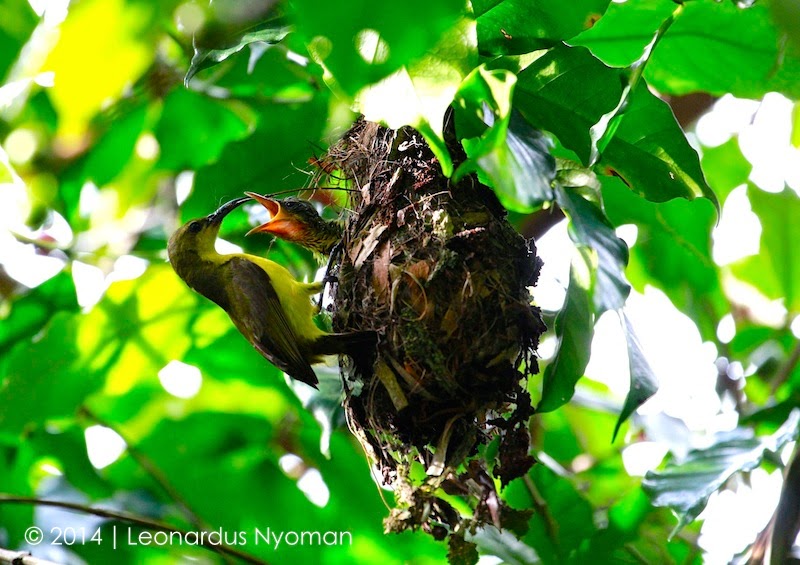
Exotic birds -Yellow-bellied Sunbird, Cinnyris jugularis


The Olive-backed Sunbird, Cinnyris jugularis, also known as Yellow-bellied Sunbird and formerly Nectarinia jugularis, is an Asian sunbird.

Diet / Feeding
The sunbirds are a group of very small Old World passerine birds which feed largely on nectar, although they will also take insects, especially when feeding young. Their flight is fast and direct on their short wings.

Range / Distribution
The Olive-backed Sunbird is common across southern China to the Philippines and Malaysia down to northeast Australia.
Originally from mangrove habitat, the Olive-backed sunbird has adapted well to humans, and is now common even in fairly densely populated areas, even forming their nests in human dwellings.

Description
They are small songbirds, at most 12cm long. The underparts of both male and female are bright yellow, the backs are a dull brown colour. The forehead, throat and upper breast of the adult male is a dark, metallic blue-black.

Breeding / Nesting
The birds mate between the months of April and August. Both the male and the female assist in building the nest which is flask-shaped, with an overhanging porch at the entrance, and a trail of hanging material at the bottom end.
After building the nest, the birds abandon the nest for about a week before the female returns to lay one or two greenish-blue eggs. The eggs take a further week to hatch. The female may leave the nest for short periods during the day during incubation.
After the chicks have hatched, both male and female assist in the care of the young, which leave the nest about two or three weeks later

Copyright: Wikipedia. This article is licensed under the GNU Free Documentation License. It uses material from Wikipedia.org ...
Photography by Leonardus Nyoman
www.FloresExoticTours.com.

Saturday, August 10, 2013

Upacara Roko Molas Poco


Upacara Roko Molas Poco
Kampung Leda - Ruteng 9 Agustus 2013.

Dilihat dari segi kata, Roko berarti mengambil, Molas diidentikkan dengan wanita cantik dan Poco berarti gunung.
Upacara ini merupakan upacara pengambilan kayu di hutan yang digunakan sebagai tiang utama dalam pembuatan rumah adat (mbaru tembong).
Dalam upacara ini “Molas Poco” yang diambil untuk dijadikan tiang utama (Siri Bongkok) yang akan dibuat dan diletakkan di tengah-tengah rumah adat yang akan dibuat; dan rumah adat yang akan dibuat tersebut berbentuk kerucut dan bagian ujung atas rumah dipasang tanduk kerbau (rangga kaba).

PUAR = ANAK RONA ULU DE  GOLO/BEO
Neka  pande nggosak agu locak adak tana Manggarai, Ai adak situ ceca mose dite. Ceca situ  mbate dise ame - pedeng dise ende – serong dise empo. Eme nggosak  adak tana manga loang mose. Lupi nitu luang. Mose luang hitu mose tenggeng, lako le ca wa’i.  Hitu tara nggoo’n: reku  agu meku nai kudut riang adak tana Manggarai.

Mbaru bate kaeng:
Mbaru hitu betuan mbau  ru. Manga mbau one mose. Ite  perlu  mbau. Eme kolang leso bombang,ili laing mbau konang, eme tik leso biring  ili laing  mbau kilit. Konang  agu  kilit hitu haju. Haju mesen perlun one mose dite. Te pande  mbaru perlu haju. Perlu haju te pande siri bongkok, leba, kinang, banggang. siri  bongkok ba lemai  poco. One ntaung 2013 tanggal 9, du pande mbaru gendang Leda, du emi siri bongkok,manga dere,”kole  o  rewung  kole  le, o roko   molas  poso  kole le”. 
Siri bongkok hitu one rapang  dite Manggarai   molas  le mai poco. Le hitu  beon. Le hitu kaeng data tua’n.  Beo ho’o manga nain latang molas  hitu ( haju te siri  bongkok), ongo emin. Paka pecing one weki dite. Ata molas ho’le poc o ata tuan. Betuan: Puar  hitu anak rona de golo. Perlu hiang anak rona. Co’ tara perlu hiang anak rona.  Kudut berkat mose dite.

Peden:
Puar  neka  lusa, apan kole te pande  uma. Jurak eme lusa puar
Golo  neka coco (poro). Eme coco (poro) golo tegi ronco / dopo  / wotos
Wejang neka nggelak. Nggelak wejang  pande  mesa ceca. Wejang  tempat asi, te mora mael tuke angkep, te mora masa lako satar
Osang neka  ngkolak. Ngkolak osang tegi rongkas agu  mora.
Kudut adil mose dite one lino, perlu hiang  atahae, uma duat,compang dari agu poco le.

Referensi:
Foto oleh: Leonardus Nyoman (leonardus.nym@gmail.com)

Monday, August 20, 2012

Caci Dance-Manggarai-Flores-Indonesia

Caci – more than just a traditional Manggarai dance
Caci, a ritual whip fight, is a major element of Manggarai cultural identity. Being a unique and aesthetic delight for spectators, caci performances are an attraction to foreign as well as domestic visitors of Manggarai. Caci is played out by two male adversaries, with one of them usually coming from another village to compete. Spectators support their favorite party by cheerfully shouting out their encouragement, making it a very lively event. Caci equipment, consisting of a whip, a shield, masks, and sticks, bursts with symbolism: the aggressor’s whip is made out of rattan, with a leather-covered handle. It symbolizes male, the phallic element, the father, and the sky. The defender’s round shield represents the female, the womb, and the earth. It is usually made out of bamboo, rattan, and covered with buffalo hide. As these meanings suggest, the male and the female elements are united whenever the whip hits the shield – symbolizing a sexual unity as an essential premise in giving live. The players’ heads are covered with a wooden or leather mask wrapped with cloth and goat hair that hangs down at the back. The two horns of the mask represent the strength of the water buffalo. For additional protection from the ashes of the whip, the defender holds a stick in his left hand.

While fighting, the men wear a traditional songket (woven cloth) over a pair of regular pants. A belt of bells worn on the hip and a string of bells strapped on the ankles create a peculiar sound. The upper body remains bare and uncovered, leaving it exposed to the whips’ lashes.

After a starting signal, the whip and shield duel begins. The fighters shuffle their feet and raise spectators’ tension by running back and forth towards each other. The aggressor tries to hit his opponent’s body with the whip. However being hit does not automatically mean losing the game – it is more important which part of the body is hit in deciding the winner. A hit in the face or on the head means losing the game; a hit on the back, though, is a good sign, promising that next year’s harvest will be prosperous. The roles of aggressor and defender are reversed after every whip strike, and, after four trials, a new pair of opponents will take their chance. Even though it is a playful event, caci also has a sacrificial function: the blood that is shed from the wounds caused by the whips is an offering to the ancestors, who, in return, will ensure the fertility of the land.

Caci used to be performed frequently during Penti, a festival held after harvest to end the old agricultural year and begin the new one. Being part of the integral ceremonial and ritual context of Penti, caci was never performed as a stand-alone event. The performances lasted at least one day – more often two or three days – always accompanied by drum and gong music. The preparations for caci required many fixed ritual procedures accompanied by animal sacrifice. Other occasions for caci performances included marriages, births, and funerals. The functions of caci were manifold: besides being a social event and a way to fulfil obligations of offerings to the ancestors, it is also an opportunity for young men to prove their virility and – in the past – a means of conflict management for disputing villages.

With changing social and agricultural circumstances, and the increased interest of domestic and international tourists in this cultural attraction of Manggarai, caci performances have also turned into a business for local cultural cooperatives. As most visitors do not want to spend a whole day or more watching caci, the length of the performances is drastically reduced, showing only fragments of the process. Some people criticize that caci fights performed on demand are alienated from their original ritual and ceremonial context, and thus lose their authenticity.

However, the growing interest of foreign visitors has definitely increased the pride and self-consciousness of the Manggarai people in a fascinating element of their culture.

The best time to see caci in its original context is during Penti, which usually takes place in the dry season between July and November, depending on the region. Nowadays, most villages celebrate Penti at five-year intervals.

If you happen to be in Manggarai in the dry season, just ask the local people if there is an upcoming Penti festival. If you are lucky to be invited to a Manggaraian marriage ceremony, you might also get the chance to see caci.
sources: www.florestourism.com

Friday, November 4, 2011

Ruteng Manggarai Flores -Indonesia


Ruteng, the capital of the Manggarai district, is located at the foot of a high mountain range and in the center of a complicated network of valleys, which flow into the largest  rice-producing areas of Flores. Besides, the area around Ruteng is an important Indonesian coffee-producing area.
Due to its high altitude, Ruteng offers a pleasant, cool climate for relaxing. The mainly Catholic town is comparatively large, with supermarkets, various shops, and a soccer stadium. A lively market located towards the south of Ruteng is a central meeting point for people from the surrounding villages.
When driving into Ruteng you will certainly notice the red chapels of the Ruteng Cathedral, standing proudly in the town’s center. If you want to have an inside look, ask for the friendly pastor who is happy to show you the cathedral.
Long-standing traditions are still very much present in Ruteng, e.g. Caci: a whip fight which is an important element of traditional ceremonies. It is therefore often performed during the marriage of the wealthier and more influential Manggaraians. If you would like to experience such a ceremony, just visit the local market and ask the people there. Try to find someone who can translate your questions into the local language to avoid misunderstandings.
In Kampung Ruteng (or Ruteng Pu’u), which used to be an important ritual site, you can see a nice example of Manggaraian ‘compang’, a village center with the typical stone altar. The village is four kilometers north of Ruteng.
Facilities
As Ruteng is a comparatively large Florenese town, it offers a range of accommodation and restaurants for tourists. The restaurants mainly serve Chinese, Indonesian, Florenese, and Western cuisine. As there are no star-rated hotels yet in Ruteng; the standard of the accommodation rather corresponds to the expectations of budget travelers.
How to get there
As Ruteng is situated on the Transflores ‘highway’, it is easily reachable from every larger Florenese city. There are buses from Larantuka, Maumere, Ende, Bajawa, and Labuan Bajo that stop in Ruteng. From Labuan Bajo it is about a six-hour drive (140km); from Ende it will take you around ten-hours to reach Ruteng.
(source : www.florestourism.com)

Friday, October 29, 2010

Liang Bua
A Prehistorie Habitation Cave

Liang Bua is a limestone cave in the Manggarai Regency of which Ruteng is the administrative centre. Although much of the regency comprises infertile limestones,some part of very suitable for paddy field cultivation and the area generally is known as “The rice bowl” of flores region.

As well as having rich natural resources,Manggarai regency also has a wealth of archeological sites. These include Liang Bua (Meaning,”Cold Cave” in the manggarai Languange), Which is located 14 km Nordwest of Ruteng, about 500 m Above sea level.
Liang Bua is ideal for human occupation, it is 50 m long, 40 m wide, and 15 m high at the dripline.The Wae (river)Racang and wae mulu rivers are about 200 m to the north ,and both contain stone artifacts and raw materials suitable for stone artefact manufacture, including silicified tuff, chalcdony, and chert.

The first scientific work at Liang Bua was undertaken in 1965 by father Theodorus Verhoeven, a catholic missionary based at the Mataloko seminary. He first visited the cave when it was being used as a local elementary school. His excavations yielded high concertrations of stone artefacts, burials and pottery, which proved the archeological potential ot the site.

After Verhoeven, the next excavation were undertaken by prof.R.P.Soejono from the indonesian National Research centre for Archaeology (now National research and development centre for Archaeology) between 1978 and 1989.
This showed that the site contained stratified cultural deposits spanning the Palaeolithic, Mesolithic,Neolithic, and Palaeo-Metallic periods.Radiocarbon dates from 3 metres depth also showed that the site was occupied by modern humans from at least 10.000 years ago.

The most recent excavation were undertaken as collaboration between Prof.R.P.Sujono and Prof.Mike Morwood (University of new England, Australia) between 2001 and 2004.
The field coordinator undertaken by Thomas Sutikna, Jatmiko and Wahyu Saptomo. This was an inter-disciplinary study that included specialist input from geology, geomorphology, palaeontology and palynology. It aimed to investigate the earliest occupation levels, and to obtain information on the site and its context.

These archaeological excavations reached a maximum depth of 10.7 metres without encountering bedrock. Beneath a layer of tuffaceous silts from a volcanic eruption around 11.000 years ago. The researchers found high concentrations of stone artefacts and hearths with the butcherred remains of Stegodon (an extintct type of elephant), Komodo dragon, tortoise, varanus rat and bird etc.

This evidence dates from 95.000 to 12.000 years ago and is associated with a new species of human : Homo Floresiensis . In fact , a skeleton found at 6 metres depth and dated to around 18.000 years ago, is the type specimen for this species. It was of an adult women aged 30, who stood about 106 ch high with a brain only 380 cc in size-compared with the modern adult average of 1200 cc.
This site therefore has great scientific significance for indonesian and world archaeology. It is a valuable educational and economic resource for local people.

Source: The National Research and Development centre for Archaeology
www.indoarchaeology.com