Showing posts with label larantuka. Show all posts

Saturday, September 24, 2016

Notes on the History of Territorial Categories and Institutions in the Rajadom of Sikka


Notes on the History of Territorial Categories and Institutions in the Rajadom of Sikka

Portuguese Missions and Administrative Territories Created by the Dutch

The earliest European presence on Flores was that of the Portuguese, who established missions around the contemporary town of Larantuka at the eastern end of Flores and on the islands of Adonara and Solor. Not long afterward, at least seven Portuguese mission stations were established on the island of Ende and on the coast of Ende Bay. Between Larantuka and Ende, the Portuguese presence was sparser, but Visser (1925: 292) locates two stations on the north coast of central Flores, at Dondo on the western end of Maumere Bay and at ‘Krove’ on the north coast near contemporary Nebé. According to Visser, the station at Krowé was founded between the years 1561 and 1575.
In addition, Visser cites evidence that Paga in the south-western reaches of Kabupaten Sikka and Sikka Natar itself were the sites of such stations on the south coast. While there is only a vague tradition among the contemporary people of Sikka Natar that their village was the site of a Dominican mission station, as Visser reports, it is possible that the village was, if not a Dominican station, then at least a place visited more or less regularly by Dominicans embarked on the Portuguese ships that passed along Flores’s south coast. Visser’s source identifies the station at Sikka as a ‘parochie’ bearing the name Saint Lucia, and as a congregation numbering 1,000 souls in 1598.
The earliest mention of Sikka I have found in the literature is that in an unattributed description of the first Christians of the islands of Solor and Timor, which de Sá includes in his compilations of documents from the period 1568-79 relating to the history of Portuguese missions in the Orient:

Map 1: Dominican mission stations on Flores, Adonara and Solor in the 16th century (after Visser 1925: 292)

On this island of Larantuka, there would be fifteen leagues between the main settlement, that is referred to by the same name [i.e., Larantuka], and another that is further ahead on the island, called Siqua [Sikka], and another called Pagua [Paga]. Ende is another fifteen leagues beyond. All are Christian settlements, of one thousand firearms, and the majority, in addition to many other Christians and pagans, are our friends, having the aforesaid weapons.
Just how frequent and intense was the contact between the Sikkanese and the Dominicans in the 16th and 17th centuries is an important question for which I have no answer. But it is likely that the contacts, and thus the direct influence of the Portuguese on the locals, were mainly on the coasts. Having said this, surely some Portuguese must have ventured inland from time to time (as from Krowé south into Tana ’Ai?) and surely people from the interior must have travelled to the coasts, if only to have a look at the foreigners—no place in east central Flores being more than a day’s walk from the north or the south coasts. Evidence for at least indirect Portuguese influence in the interior is strong. For example, a small number of not-too-mangled Portuguese words turn up in transcriptions of ritual speech I recorded in Tana Wai Brama in the 1970s and 1980s.

The Dutch acquired Flores from the Portuguese in 1859 but it was some years before they became sufficiently interested in the region of Sikka to send a government official there. When that happened in the 1870s, the official settled not in Sikka Natar, the Village of Sikka on the south coast and the home of the rajas, but at Maumere on the north coast. Maumere was then a low-lying, hot, malarial place, sodden in the rainy season and smoky and dusty in the dry. It has since grown into one of the largest towns on Flores, a centre of education, and, with its excellent harbour and landing strip, a major port of entry for Flores and a commercial centre.

According to Dutch records and the hikayat of Kondi and Boer, much shuffling of allegiances and shifting of local negeri (villages, but in the hikayat, clearly the Malay equivalent of tana, ‘domains’) between the two (and for a while, three) rajadoms of Sikka went on in the two centuries before 1925. One effect of the shifting of negeri (each of which was probably a tana with its own tana pu’ang) and the rise of Sikka as a secular polity under the rajas of Sikka was to erode the importance of what the early Dutch records call tana pu’ang-schappen (tana pu’ang-ships). Once this process of incorporation into the rajadom and erosion of the tana pu’angs’ authority was complete—by about 1950—the local tana pu’ang retained respect in their communities, but no longer exercised any real power.

Here we encounter the limitations of the scarce historical sources on the early culture and history of Sikka and a peculiarity of the voluminous later manuscripts written by Sikkanese authors. Briefly, the problem is this: the authors of the first texts written by a few men of the first or second literate generation of Sikkanese were all officials in the government of the Rajadom of Sikka. The two major texts from that era, one by D.D.P. Kondi and the other by A. Boer Pareira, treat the history of Sikka in detail, but from the distinctive point of view of Lepo Geté, the ‘Great House’, the Royal House of Sikka. Since the people of Lepo Geté are, according to their own myth of origin, immigrants to Flores and by no means indigenes, their history cannot be taken to be the history of the indigenous Sikkanese peoples, which remains a subject about which we know very little. Furthermore, even the main outlines of the internal divisions of the Sikkanese people into communities is obscured, firstly by the Dutch, who created the administrative districts of the rajadom, and then by the early Sikkanese authors, who were little concerned with explaining the territorial categories and institutions of the indigenous social landscape but were concerned centrally with the creation of the Sikkanese rajadom and the legitimation of its rule.

Although information about early Dutch activity in Sikka is sketchy at best, we can get at least a general idea of what was going on in the old rajadom between about 1860 and 1942. Indeed, the picture becomes a bit more detailed once the Dutch, with their penchant for archiving the memories van overgave of their officials, arrived in Sikka.

The Dutch administrative divisions of Flores, which must quickly have become territorial categories in the minds of the Florenese (‘I am of Ende’, ‘He is from Sikka Maumere’, ‘They are Larantukans’), changed often in the years from 1879 until 1942, when the Dutch flag over Flores was replaced briefly with the Japanese rising sun. From 1879 to 1907, these were the administrative divisions of Flores (Map 2):


Map 2: Dutch administrative divisions of Flores, 1879-1907

Note that this was before the Dutch had adjusted administrative boundaries to coincide with the rajadoms they later recognised on the island. Manggarai in the west was part of Gouvernement Celebes en Onderhorigheden (Government of Celebes [Sulawesi] and Dependencies) while the rest of Flores was administratively part of Residentie Timor en Onderhorigheden (Residency of Timor and Dependencies). Within the Residency of Timor, South Flores (Zuid Flores), which included Ende, most of Nage Keo and some of Ngada, was part of the Division (D: Afdeling) of Sumba and Dependencies while the rest of Flores was the Division of Larantuka and Dependencies. Larantuka was divided into the subdivisions or districts (D: Onderafdelingen) of North Flores (which included Sikka and Maumere, which the Dutch had made the administrative centre of the subdivision), East Flores, Solor and Alor. This administrative division of the island did not work too well, as a brief glance at the map might lead us to suspect, and so, in 1907, the lines were redrawn as follows (Map 3): 

Map 3: Dutch administrative divisions of Flores, 1907-09

In these years (1907-09), Manggarai remained part of the Government of Celebes, while the rest of Flores was the Division of Flores and was included in the Residency of Timor. South Flores was removed from the Division of Sumba and made part of the Division of Flores, which was divided into the Subdivisions of South Flores, North Flores, East Flores and the Solor Islands. This arrangement should have worked all right, except that, in 1908, an administrative division between West Flores and East Flores was created. The new division crosscut South Flores and North Flores and must have been the source of innumerable headaches for the officials assigned to the island. But those headaches lasted only two years.
In 1909, the divisions of the island were shuffled once again, in such a way as to bring the administrative divisions into accord with at least some of the rajadoms on the island (Map 4).


Map 4: Dutch administrative divisions of Flores, 1909-31
Manggarai was removed from the Government of Celebes and made a subdivision (onderafdeling) of the Division of Flores. The old divisions of South Flores, North Flores and East Flores disappeared and were replaced by subdivisions (onderafdelingen) that took greater account, though roughly, of the linguistic, social, economic and, perhaps most important, the political realities of the island. These were (in addition to the Subdivision of Manggarai) the Subdivisions of Ngada (including Nage Keo), Ende (including Lio), Maumere, East Flores (including Larantuka) and the Solor Islands. The subdivisions were further divided into districts (landschappen). Most of the names of the districts corresponded with the names of socio-linguistic groups on the island. The new district and administrative arrangements were comparatively rational, since they took account of the native rajadoms the Dutch had either recognised or created in the previous 50 years. In particular, the three rajadoms of the District of Maumere, Sikka, Nita and Kangae, were clearly demarcated. This arrangement of administrative divisions survived until about 1930, when some of the rajadoms were amalgamated.
Joachim Metzner has given us the following reconstruction of the political divisions of eastern Sikka towards the end of the 19th century. This would have been some 20 years after the earliest entries in the Dagboeken van het Controleuren van Maoemere, which were kept, more or less faithfully, by the posthouders assigned to Maumere, beginning in 1879, but before the dispute between the rajas of Sikka and Larantuka over Tana ’Ai was settled (Map 5). 

Map 5: Political divisions of Sikka towards the end of the 19th century and before Dutch intervention in the border dispute between Sikka and Larantuka

 Map 6: Political divisions of Sikka in the early 20th century after Dutch intervention

More certain are the political divisions of the District of Maumere after the boundaries established by the Dutch after they settled the Tana ’Ai dispute at the beginning of the 20th century. The settlement placed Tana ’Ai within the Rajadom of Kangae (Map 9).

Here we see plainly the way the Dutch, by 1904, recognised the indigenous polities of the Sikka region, which were ruled by the Raja of Sikka, the Raja of Nita and the Raja of Kangae. The Raja of Kangae ruled a region created by the Dutch when they could find no other way to control the subversive and overtly hostile activities of one Raja Nai against the authority of the Raja of Sikka. These boundaries—around what the Sikkanese called kapitan-schappen—correspond roughly to the kecamatan into which the kabupaten is divided today.

By 1929, the Dutch acceded to the amalgamation of the Rajadoms of Nita and Kangae into the Rajadom of Sikka, whose raja, Mo’ang Ratu Thomas Ximenes da Silva, ruled the whole of the region of Sikka until his death in 1954. The dissolution of the Rajadom of Kangae, which had been born of a rebellion against the Raja of Sikka in the first decade of the 20th century over a question of taxation, followed the enforced settlement by the Dutch of the dispute between the rajas of Sikka and Larantuka over sovereignty over Tana ’Ai, which became firmly part of the Rajadom of Sikka. The Rajadom of Nita, whose rulers were kinsmen of the Raja of Sikka, was also dissolved and its territory placed under the rule of Sikka, partly as an administrative convenience for the Dutch but also in response to the political activity and persuasiveness of Raja Don Thomas, the last of the Sikkanese rulers.
After 1931 and until the beginning of the Japanese occupation in 1942, the administrative map of Flores was as depicted in Map 7:
Map 7: Administrative divisions of Flores, 1931 to early 1950s

These boundaries were those of the rajadoms of Flores within the Division of Flores. Under the government of the newly independent Indonesia, the rajadoms were abolished in the early 1950s, after which the old divisions, and their boundaries, were retained as kabupaten in the new system of government.


Monday, January 23, 2012

Semana Santa, Larantuka Flores


THE LARANTUKA “SEMANA SANTA” UNIQUE HOLY WEEK CELEBRATIONS


Each year, the week before Easter Sunday,  the town of Larantuka, East Flores, solemnly celebrates the Holy Week, popularly known here as “Semana Santa”.  The pinnacle of these celebrations is the commemoration of Christ’s  suffering on Good Friday by following the stations of the Cross, known here as the “Sesta Vera”.  In Larantuka, prayers center around two religious icons, one is the statue of Jesus Christ (locally known as Tuan Ana) and the other is that of the Virgin Mary (Localy known as Tuan Ma). Both are original statues brought here by Portuguese missionaries Gaspar do Espírito Santo and Agostinho de Madalena in the 16th century. These statues are presented to the public only during Easter and are kept out-of-view for the rest of the year.
Located on the eastern tip of Flores Island, - Larantuka,-  also known as ‘Kota Reinha’ or ‘Tana Nagi’, is the capital of the district of East Flores.

Having strong Portuguese colonial influences, the town is commonly known as one where Catholicism flourishes in Indonesia. For more than four centuries, this region inherited Catholicism through the role of the common people rather than through the clergy. The King of Larantuka, missionaries, the brotherhood of apostles of the common people (Confreria), the  Semana Tribe, and the Kakang (Kakang Lewo Pulo Tribe) as well as the Pou (Lema Tribe) have played pivotal roles in the development of Catholicism in this Larantuka region.
During Holy Week, the normally quiet and tranquil town will be filled with pilgrims and congregations from many parts of Indonesia and from around the world.
The Semana Santa commences with the Rabu Trewa or the Shackled Wednesday (or Ash Wednesday)  on the mid-Easter week. On this day, devotees gather in chapels and pray, remembering the betrayal of Jesus by Judas Iscariot which led to Jesus’ arrest and shackling. This is the time when the town of Larantuka turns into the Town of Mourning; a time when it drowns into solemnity and reflection for the purification of the soul.
In the afternoon of Maundy Thursday, devotees enact the tikam turo ritual in preparing the route for the following day’s seven kilometer procession by planting candles along the route. At the Chapel of Tuan Ma (Virgin Mary) the casket that has been sealed for one year is carefully opened by the Conferia, and the statue of Tuan Ma or Virgin Mary is bathed and then dressed in mourning clothes (a piece of black or purple, or blue velvet coat).
The pinnacle of the rituals falls on Good Friday or the Sesta Vera. The door of the chapel of Tuan Ma and Tuan Ana (Jesus and the Virgin Mary) opens at ten o’clock in the morning. The Good Friday procession is highlighted by the ritual of carrying the body of Jesus Christ, placing Jesus at the center of the ritual and placing Mother Mary at the center of attention, as the mourning mother (Mater Dolorosa). The Sabtu Santo (Holy Saturday) and the Minggu Paskah (Easter Sunday) follow the next days, marking the end of the entire Easter week procession.

Tuesday, April 5, 2011

East Flores, East Nusa Tenggara Province


Flores Timur – East Flores

Due to its remoteness and limited accessibility, Flores Timur is probably the area of Flores, which is least explored by tourists. The culture of the people of Flores Timur has also been less in the focus of anthropological research than its western counterpart. However, this does not mean that there is nothing to see in the easternmost part of the island. Apart from traditional villages, unique ikat weaving, volcanoes and beaches, Flores Timur’sdistrict capital has a long history of trade and missionary activities. If you take time to explore this district, you will certainly be rewarded with an experience of extraordinary hospitability from the local people.
When traveling around Flores Timur, you may notice that there are hardly any ‘sawah’ – or rice paddies. With its hot and dry climate, Flores Timur only gets a little rainfall. Wet rice cultivation is rather difficult, and the people mostly rely on dry land farming, with corn being the major crop, followed by tubers and dry rice. The yields are rather small. As living here is definitely harder than elsewhere on Flores, the migration rate is quite high. Many people from Flores Timur look for better livelihood opportunities in other parts of Indonesia.

The majority of the people in Flores Timur are Lamaholot, followed by the Solorese and the Larantukanese. Lamaholot is more a language than an ethnic group, and the linguistic boundaries do not exactly correspond to the political borders. The Lamaholot people do not only live in East Flores, but also on the islands of Solor, Adonara and Lembata. Even though they share many common cultural elements – e.g. the widespread practice of the use of elephant tusks as a part of the marriage presentation - Lamaholot people do not consider themselves to be a cultural unity.

Places to go
Larantuka
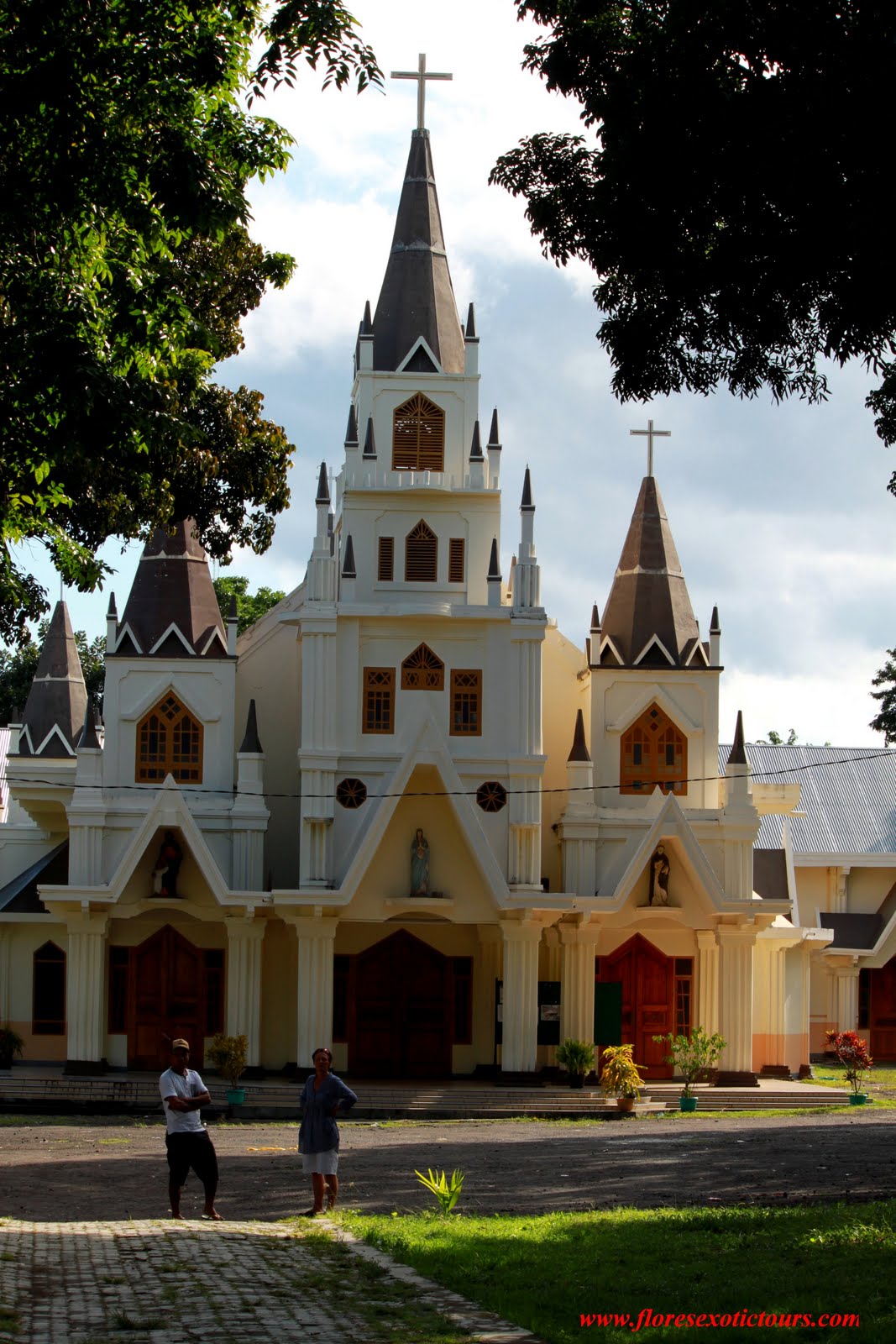
Larantuka is the capital of Flores Timur. This coastal town used to be a naval base for trade and a centrepoint of colonialisation and clerical activities in Eastern Indonesia. Nowadays, Larantuka is still an important connecting port to the neighboring islands and the centre of economic activities in the Flores Timur district, attracting many people from the neighbouring villages to make a living in the town. Having a long Catholic history, Larantuka hosts the famous KatedralReinhaRosari, or Teinha Rosary Cathedral. This cathedral, together with the two well-known chapels CapelaTua Ana and Capela Tuan Ma, are the centre of activity during the famous Larantukan Easter procession. During Easter, this laid-back city turns into a busy and lively place bursting with pilgrims from all over the world.

Leworahang/Ilepadung
If you are in Larantuka or on the Trans Flores Highway between Maumere and Larantuka, don’t miss stopping at KampungLeworahang (kampung meaning village in Indonesian). This subvillage of Ilepadung is situated near a nice stretch of beach in a luminous spot of land, where beautiful trees surrounding the village centre invite you to take respite from the burning midday heat. The friendly Lamaholot people of Lewoharang, who mainly work as farmers or fishermen, are the proud owners of three traditional well-maintained houses.
As you enter the village, you will find the korke, Leworahang’sadat house, standing on wooden piles behind the big stone-pile village centre. Being the centre of many traditional ceremonies, the korke is furnished with ornamental carvings. Prominent carvings are the bird and the fish, which stand symbolically for the newcomers who arrived from land and sea to become the Lords of the land of Leworahang . Inside the korke, ritual objects such as drums and gongs are stored. Nuba, a flat erected stone close to the Korke, is the place for the villagers to make prayers and offerings to their ancestors.

LangoBele, which means ‘big house’ in the Lamaholot language, is the house of the first man who lived in Leworahang – so people say. The entrance of this charming alang-alang (or thatched) roofed bamboo house is furnished as a cozy resting pace. Inside the house, there is a sleeping area as well as two small rooms elevated from the ground. Ornate baskets in different sizes hang on the wall, as well as bejowong, which is a traditional place to store food.
A little bit further inside the village you will find kebang. Built on massive wooden piles, the kebang used to be storing places for corn and rice, rather like raised open barns. The flat round pieces of wood above the piles keep mice and rats from eating the valuable yields. In front of the kebang, is anuba. The pig jaws attached to the corners of the kebang (you will also find them at the korke)symbolize the strength of the villagers and their devotion to maintain their ancestors’ customs.
Even though the traditional houses are Leworahang’s main attraction, the village has a lot more to offer. Ikat is the vital element toceremonial life of theLeworahang people, and you will most likely see some women working on these beautiful cloths. The production of moke, a local alcoholic beverage made out of the sap of the lontar palm, is another interesting activity. Besides being a source of income, the moke is also used at ceremonial occasions. Last but not least, Ilepadung is also a centre of cashew nut processing. This work requires skillful hands and caution: the sap of the nut’s peel is a skin-irritant, and the nut itself is a very delicate product. The returns on cashew nuts, which are sold to fair trade organizations, adds another additional income source to subsistence farming.
Traditional ceremonies still play an important role for the people of Leworahang, above all ahikkokor, which is the annual ceremony for the renovation of the korke. Ahikkokor is usually held around the end of March. It involves dancing and music, praying, communal meals, as well as the ritual sacrifice of many pigs, whose jaws will be disposed at the korke and the kebang, as previously mentioned.
Lewoharang has not received many foreign visitors yet, and it is a little bit difficult to find someone there who can guide in English. You can ask for ArnoldusHurit, a young enthusiastic local who published a little booklet about the culture of Ilepadung. He is eager to show you around, though he is not always available. If you travel to Lewoharang on your own, please ask the local people for permission to see the traditional houses upon your arrival.
Lewoharang can only be reached by private transportation - motorbike or car, since there is no public transportation that passes through the village. The distance from Larantuka to Lewoharang is ±30 km, from Maumere±122 km; the road from the small junction that leads off from the Trans Flores Highway to Ilepadung is about 12 km. Turn onto this road and go straight ahead to the next small junction. There, turn left again onto an unpaved road,which leads you along a beautiful stretch of the sea, passing a market building, to Ilepadung. If you want to see the traditional houses, take a left turn just before the entrance, and after some hundred meters you have reached your destination.

Lewokluo
If you get infected with ikat-passion during your Flores trip, Lewokluo is a place that will fill your collector’s heart with awe. This small Lamaholot village is well famed for its ikat, or kwatekkingein the local language. What makes their ikatunique and therefore a sought-after handicraft,are the small sewn-in seashells, which are collected by the villagers on a shore nearby the village. The kwatekkinge is not an ordinary cloth that is worn every day. Used as part of the marriage presentation, it has a ceremonial function and is of special meaning and value to the Lewokluo people. The kwatekkinge is made out of natural local ingredients, including the cotton and the dye. Even though there exists a local association of weavers named sanggarUtoWata, there are not many women left who own the extensive skills and knowledge that it takes to manufacture a kwatekkinge. All these facts considered, the price to pay for such an object of desire is accordingly high.
There is no public transportation passing Lewokluo. By car or motorbike it takes about 26 km from Larantuka and 114 km from Maumere. The road off the Trans Flores Highway that leads you to Lewokluo takes another 2 km.

Cultural highlights
Easter in Larantuka
Easter activities are initiated one week before Easter with the semana sancta, or, the Holy week – a time of self-reflection and confession. The central characters of the Easter ceremony in Larantuka are two statues that were brought to Larantuka in the 16th century by Portuguese missionaries. These statues of Jesus and the Virgin Mary are kept away in the CapelaTua Ana and the Capela Tuan Ma throughout the year. Only during Good Friday, the peak event of the Easter ceremony, are they taken out of their closet. Good Friday starts with the opening of the Capela Tuan Ma for the people to come and pray at the Virgin Mary statue. Also in the morning, the statue of Jesus is carried out from the Capela Tuan Ana and brought to its counterpart, the Virgin Mary, in a procession of about 7km. During the procession, the litigants stop at eight small chapels to pray and to remember the suffering of Jesus. When the two statues are finally united, they continue their journey together to the KatedralReinhaRosari, where a crowded nightlong Good Friday mass will be held.
If you want to experience the Easter procession, it is highly recommended to book your accommodation well in advance, as you will find no vacant rooms during Easter.

The Larantuqueiros
From the early 16th century on, Portuguese sailors and traders used Larantuka as a hub in the flourishing sandalwood trade on Timor Island. They were followed by Dominican missionaries, who had fled from the Island of Solor, after its takeover by the Dutch. As some of the Portuguese settled down in this area, they started to marry local people, herewith building up a new community. By the end of the 16th century, these Larantuqueiros or Topasses – or ‘black Portuguese’, as they were called by the Dutch – had developed their own distinct culture in Larantuka and later also in some parts of Timor Island. They used Portuguese as their formal language and adapted the Malay language for trade. Formally, the Larantuqueiros were subjects of the crown of Portugal and close to the Dominican mission, but as they were successfully resistant to Portuguese control, they mostly lived under their own rules, controlling the sandalwood trade and also setting up trade networks and war alliances with the indigenous people of the interior areas. In the middle of the 19th century, the Portuguese crown sold its ruling rights in Flores – among other places in Eastern Indonesia – to the Dutch, who kept themselves in the background and did not interfere much with the daily life of the Larantuqueiro community. With the decline of the sandalwood boom, the Larantuqueiros drew back from their extensive trade activities and made a living mostly out of subsistence agriculture.
Even though the golden years of the Larantuqueiros are now history, some elements of their culture linger on. During their peak period of trade, the Larantuqueiros founded many brotherhoods, one of which, the Confraria do Rainha Rosario, has kept its presence until now and actively participates in Catholic ceremonies, above all, the famous Easter procession. Furthermore, parts of the Catholic mass are still held in Portuguese, and some Portuguese words have found their way into the Lamaholot ritual adat language as well.

Sources:
Ms.Christine Moser (swiss contact)
Arnoldus Hurit Welan, Lewoharang; and Swisscontact WISATA on behalf of the Flores DMO