'Hobbits' on Flores, Indonesia

The Island of Flores
Flores is one of many Wallacean islands, which lie
east of Wallace's Line and west of Lydekker's Line. Wallacean islands are
interesting because they have rarely, if ever, been connected via land bridges
to either the Asian continent to the west or the Greater Australian continent
to the east. This longstanding separation from the surrounding continents
has severely limited the ability of animal species to disperse either into or
away from the Wallacean islands. Thus, on Flores there were only a small
number of mammal and reptile species during the entire Pleistocene. These
included komodo dragons and other smaller monitor lizards, crocodiles, several
species of Stegodon (an extinct close relative of modern elephants), giant
tortoise, and several kinds of small, medium, and large-bodied rats.


During the 1950s and 60s, a Dutch priest named Father
Theodor Verhoeven lived and worked on Flores at a Catholic Seminary.
Verhoeven had a keen interest in archeology and had studied it at
university. While living on Flores, he identified dozens of archeological
sites and conducted excavations at many of these, including the now famous site
of Liang Bua where the "hobbits" of human evolution were discovered (Homo
floresiensis). Verhoeven was the first to report and publish that
stone tools were found in association with Stegodon remains in central Flores
at several sites within the Soa Basin. He even argued that Homo
erectus from Java was likely behind making the stone tools found on Flores
and may have reached the island around 750,000 years ago. At the time,
paleoanthropologists took little notice of Verhoeven's claims or if they did,
they discounted them outright.
Father Verhoeven sitting near the site of one of his
excavations on Flores at the Soa Basin during the 1960s. Almost thirty years later, an Indonesian-Dutch research team uncovered evidence
at the Soa Basin which confirmed Verhoeven's original findings. This team
even went further by dating some of the stone tools and fossils using
paleomagnetism (a method of determining the age of ancient sediments) and
showed they were probably around 700,000 years old. These new findings
did not become widely known within the paleoanthropological community until
additional sediments were dated using a different technique called zircon
fission-track analysis. Thus, by the late 1990s more scientists were
beginning to accept the possibility that another human species (likely Homo
erectus) had crossed the Wallace Line and reached Flores well before our
own species, Homo sapiens, had evolved in Africa around 200,000 years
ago.


In 2001, an Indonesian-Australian research team began
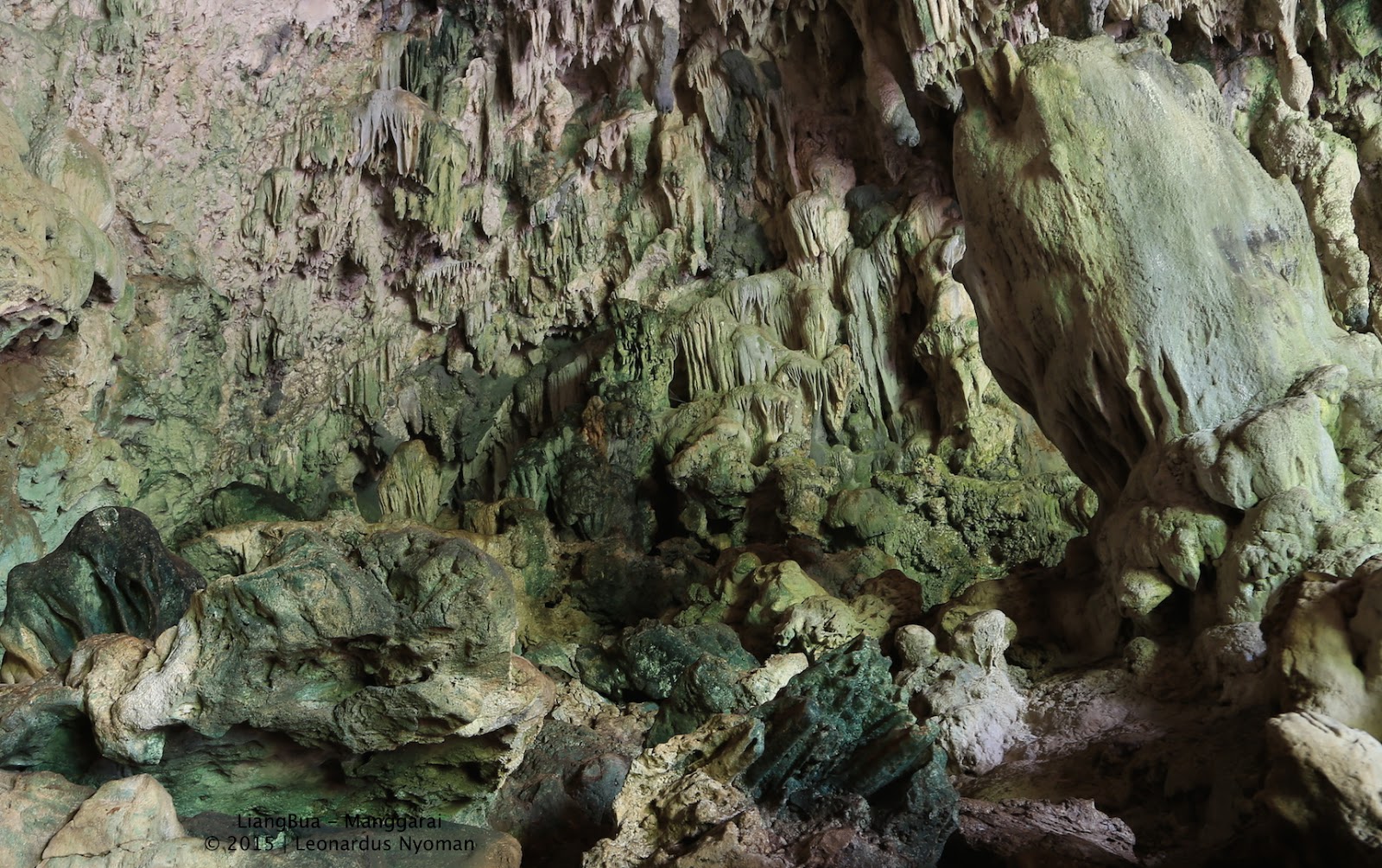
excavations at a large limestone cave located in west central Flores.
This cave, known as Liang Bua (which means "cool cave"), was first
excavated by Father Verhoeven in 1965. Professor Raden Soejono, the
leading archeologist in Indonesia, heard about Liang Bua from Verhoeven and
conducted six different excavations there from the late 1970s until 1989.
All of this early work at Liang Bua only explored deposits that occurred within
the first three meters of the cave floor. These deposits are dated to
within the last 10,000 years and contain considerable archeological and faunal
evidence of modern human use of the cave, as well as skeletal remains of modern
humans. However, in 2001 the new goals were to excavate deeper into the
cave's stratigraphy to explore if modern or pre-modern humans were using Liang
Bua prior to 10,000 years ago. In September of 2003, they got their
answer.


The Discovery of Homo floresiensis
On Saturday, September 6, 2003, Indonesian
archeologist Wahyu Saptomo was overseeing the excavation of Sector VII at Liang
Bua. Benyamin Tarus, one of the locally hired workers, was excavating the
2 x 2 meter square when all of a sudden the top of a skull began to reveal
itself. Six meters beneath the surface of the cave, Wahyu immediately
joined Benyamin and the two of them slowly and carefully removed some more
sediment from around the top of the skull. Wahyu then asked Indonesian
faunal expert Rokus Due Awe to inspect the excavated portion of the
skull. Rokus told Wahyu that the skull definitely belonged to a hominin
and most likely that of a small child given the size of its braincase.
Two days later, the team returned to the site and Thomas Sutikna, the
Indonesian archeologist in charge of the excavations, joined Wahyu at the
bottom of the square. After several days, enough of the cranium and
mandible had been exposed for Rokus to realize that this was no small child;
instead, all of its teeth were permanent meaning that this was a fully grown
adult. A few weeks later, the team had recovered the rest of this
hominin's partial skeleton, the likes of which had never been discovered before.
Today, this specimen is referred to as LB1 (Liang Bua 1), and is the holotype
specimen for the species Homo floresiensis.


At the time of the discovery, the Liang Bua Research
Team included specialists in archeology, geochronology, and faunal
identification, but there was no physical anthropologist. Dr. Mike
Morwood, the co-leader of the project, invited his colleague at the University
of New England in Australia, Dr. Peter Brown, to lead the description and
analysis of the skeletal remains. Dr. Brown is an expert on cranial,
mandibular, and dental anatomy of early and modern humans and he agreed to
apply his expertise to the study of the new bones from Liang Bua. This
important scientific work resulted in the first descriptions of these skeletal
remains in the journal Nature on October 28, 2004. This work also gave
the scientific name, Homo floresiensis, to the hominin species that is
represented by the skeletal material from the Late Pleistocene sediments at
Liang Bua.

Just before the two Nature articles on Homo
floresiensis were published in 2004, the Liang Bua Research Team uncovered
additional skeletal material. This included the arm bones of LB1, and
several bones of another individual, LB6, including the mandible and other
bones of the arm. Drs. Morwood and Brown, and other Indonesian and
Australian members of the Liang Bua Research Team, described and analyzed these
new skeletal remains of Homo floresiensis and again published their
results in Nature on October 13, 2005.


The skeletal evidence suggests that adults of this
species had extremely small brains (400 cubic centimeters), stood only about 1
meter (3'6") tall, and weighed around 30 kg (66 lbs). For their
height, these individuals have large body masses, and in this regard appear
more similar to earlier hominins like "Lucy" (Australopithecus
afarensis) than they do to modern humans, including small and large-bodied
people. The proportions between the upper arm (humerus) and upper leg
(femur) also appear more similar to those in Australopithecus and Homo
habilis than those of modern humans.


Further
Research
As additional postcranial material of Homo
floresiensis was being recovered, Dr. Morwood contacted Dr. Susan Larson
and Dr. William Jungers, of Stony Brook University Medical Center. Drs.
Larson and Jungers are experts on human evolutionary anatomy, particularly with
regard to the functional morphology of the arms and legs. Dr. Larson has
shown that the shoulder of Homo floresiensis is more like that in Homo
erectus rather than modern humans, and Dr. Jungers has demonstrated many
anatomical features of the "hobbit" foot that are shared with African
apes and early hominins like Australopithecus afarensis (e.g.,
"Lucy"). Dr. Morwood also invited hominin brain expert Dr. Dean
Falk to analyze the endocast of Homo floresiensis. Dr. Falk has
identified several features in the "hobbit" brain that suggest neural
reorganization despite its overall small size. Additional research
focused on the paleobiology and archeology of Homo floresiensis by Drs.
Morwood, Brown, Larson, Jungers, Falk, their many Indonesian colleagues, and a
large international network of scientific experts, was recently published in a
special issue of Journal of Human Evolution (November 2009). Discussions
and summaries of some of the work included in that special issue will be
presented on this web page over the coming weeks and months.
In total, over a dozen scientific articles have been
published based on analysis of the original skeletal remains of Homo
floresiensis, and hundreds of scientific articles and news stories about Homo
floresiensis have appeared in print or on the web during the past seven
years since the partial skeleton of LB1 was discovered. As excavations at
Liang Bua and elsewhere on Flores continue, we will keep you up-to-date on the
latest discoveries and scientific analyses of materials related to Homo
floresiensis, the so-called "hobbits" of human evolution.
One of our Human Origins Program researchers, Dr. Matt Tocheri who has studied
the wrist of Homo floresiensis, is looking forward to taking part in
excavations this coming summer at Liang Bua and the Soa Basin.
Sources : http://humanorigins.si.edu/research/asian-research/hobbits
Foto credit by Leonardus Nyoman
BibliographyFoto credit by Leonardus Nyoman
Argue, D., Donlon, D., Groves, C., Wright, R., 2006. Homo floresiensis: microcephalic, pygmoid, Australopithecus or Homo? Journal of Human Evolution 51, 360–374.
Argue, D., Morwood, M.J., Sutikna, T., Jatmiko, Saptomo, E.W., 2009. Homo floresiensis: a cladistic analysis. Journal of Human Evolution 57, 623–639.
Aziz, F., van den Bergh, G.D., Morwood, M.J., Hobbs, D.R., Collins, J., Jatmiko, Kurniawan, I., 2009. Excavations at Tangi Talo, central Flores, Indonesia. In: Aziz, F., Morwood, M.J., van den Bergh, G.D. (Eds.), Palaeontology and Archaeology of the Soa Basin, Central Flores, Indonesia. Indonesian Geological Survey Institute, Bandung, pp. 41–58.
Brown, P., Maeda, T., 2009. Liang Bua Homo floresiensis mandibles and mandibular teeth: a contribution to the comparative morphology of a new hominin species. Journal of Human Evolution 57 571–596.
Brown, P., Sutikna, T., Morwood, M.J., Soejono, R.P., Jatmiko, Saptomo, E.W., Rokus Awe Due, 2004. A new small-bodied hominin from the Late Pleistocene of Flores, Indonesia. Nature 431, 1055–1061.
Falk, D., Hildebolt, C., Smith, K., Morwood, M.J., Sutikna, T., Brown, P., Jatmiko, Saptomo, E.W., Brunsden, B., Prior, F., 2005. The brain of LB1, Homo floresiensis. Science 308, 242–245.
Falk, D., Hildebolt, C., Smith, K., Jungers, W., Larson, S., Morwood, M., Sutikna, T., Jatmiko, Wahyu Saptomo, E., Prior, F., 2009a. The type specimen of Homo floresiensis (LB1) did not have Laron Syndrome. American Journal of Physical Anthropology 140, 52–63.
Falk, D., Hildebolt, C., Smith, K., Morwood, M.J., Sutikna, T., Jatmiko, Saptomo, E.W., Prior, F., 2009b. LB1’s virtual endocast, microcephaly and hominin brain evolution. Journal of Human Evolution 57, 597–607.
Jungers, W.L., Harcourt-Smith, W.E.H., Wunderlich, R.E., Tocheri, M.W., Larson, S.G., Sutikna, T., Rhokus Awe Due, Morwood, M.J., 2009a. The foot of Homo floresiensis. Nature 459, 81–84.
Jungers, W.L., Larson, S.G., Harcourt-Smith, W., Morwood, M.J., Sutikna, T., Rokhus Due Awe, Djubiantono, T., 2009b. Descriptions of the lower limb skeleton of Homo floresiensis. Journal of Human Evolution 57, 538–554.
Larson, S.G., Jungers,W., Tocheri, M.W., Orr, C.M., Morwood, M.J., Sutikna, T., Rokhus Due Awe, Djubiantono, T., 2009. Descriptions of the upper limb skeleton of Homo floresiensis. Journal of Human Evolution 57, 555–570.
Morwood, M.J., van Oosterzee, P., 2007. The Discovery of the Hobbit: The Scientific Breakthrough that Changed the Face of Human History. Random House, Sydney, Australia.
Morwood, M.J., Brown, P., Sutikna, T., Jatmiko, Saptomo, E.W., Westaway, K.E., Roberts, R.G., Rokus Awe Due, Maeda, T., Wasisto, S., Djubiantono, T., 2005. Further evidence for small-bodied hominins from the Late Pleistocene of Flores, Indonesia. Nature 437, 1012–1017.
Morwood, M.J., O’Sullivan, P., Aziz, F., Raza, A., 1998. Fission track age of stone tools and fossils on the east Indonesian island of Flores. Nature 392, 173–176.
Morwood, M.J., Soejono, R.P., Roberts, R.G., Sutikna, T., Turney, C.S.M.,Westaway, K.E., Rink, W.J., Zhao, J.-x., van den Bergh, G.D., Rokus Awe Due, Hobbs, D.R., Moore, M.W., Bird, M.I., Fifield, L.K., 2004. Archaeology and age of a new hominin from Flores in eastern Indonesia. Nature 431, 1087–1091.
Morwood, M.J., Sutikna, T., Saptomo, E.W., Jatmiko, Hobbs, D.R., Westaway, K.E., 2009. Preface: research at Liang Bua, Flores, Indonesia. Journal of Human Evolution 57, 437–449.
Sondaar, P.Y., van den Bergh, G.D., Mubroto, B., Aziz, F., de Vos, J., Batu
Unkap, L., 1994. Middle Pleistocene faunal turnover and colonization of Flores
(Indonesia) by Homo erectus. Comptes Rendus de l’Academie des Sciences
320, 1255–1262.
Tocheri, M.W., Caley, M., Orr, C.M., Larson, S.G., Sutikna, T., Jatmiko,
Saptomo, E.W., Rokus Awe Due, Djubiantono, T., Morwood, M.J., Jungers, W.L.,
2007. The primitive wrist of Homo
floresiensis and its implications for hominin evolution. Science 317, 1743–1745.van den Bergh, G.D., Meijer, H.J.M., Rokhus Due Awe, Morwood, M.J., Szabo´ , K., van den Hoek Ostende, L.W., Sutikna, T., Saptomo, E.W., Piper, P.J., Dobney, K.M., 2009. The Liang Bua faunal remains: a 95 k.yr. sequence from Flores, East Indonesia. Journal of Human Evolution 57, 527–537.
van den Bergh, G.D., Mubroto, B., Sondaar, P.Y., de Vos, J., 1996. Did Homo erectus reach the island of Flores? Indo-Pacific Prehistory Association Bulletin (Chiang Mai Papers) 14, 27–36.
Verhoeven, T., 1953. Eine Mikrolithenkultur in Mittel- und West-Flores. Anthropos 48, 597–612.
Verhoeven, T., 1958. Pleistozane funde in Flores. Anthropos 53, 264–265.
Verhoeven, T. 1968. Pleistozane funde auf Flores, Timor and Sumba. In: Geburtstag von P.W. Schmidt, (Ed.), Anthropica, Gedenkschrift zum 100. Studia Instituti Anthropos 21, St Augustin bei Bonn, pp. 393–403.